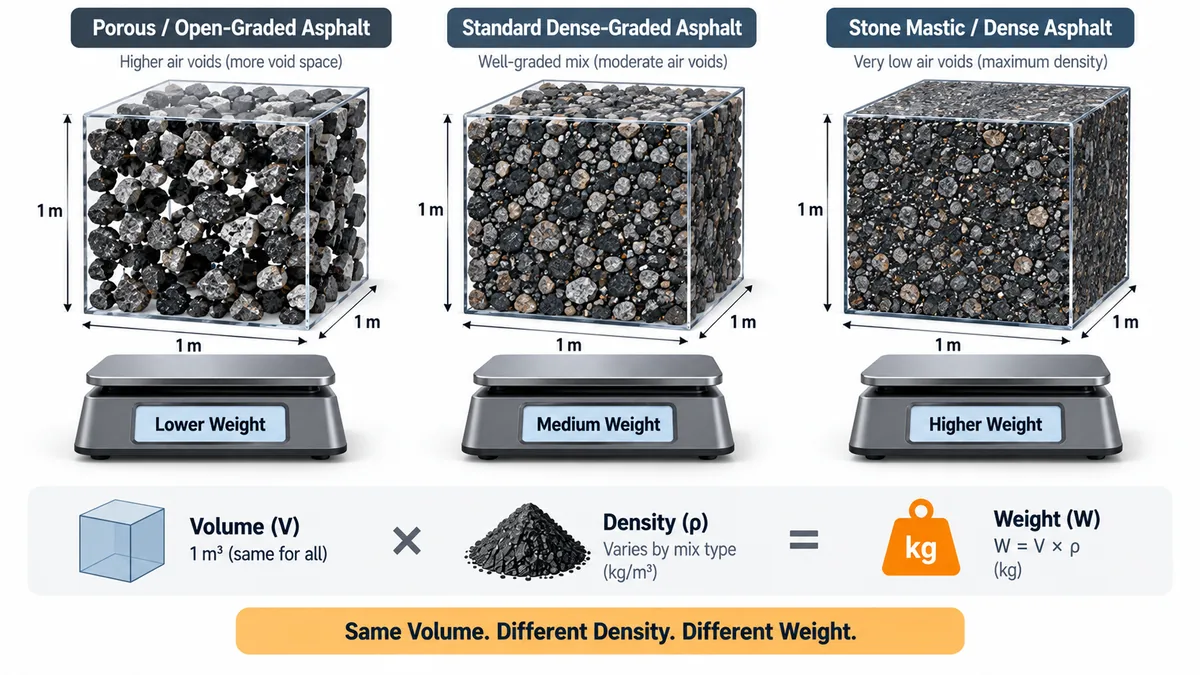
Asphalt density is one of the most important values in asphalt calculation.
It connects area, thickness, volume, weight, tonnage, and cost.
If you know the length, width, and thickness of a driveway, parking lot, road, or overlay, you can calculate asphalt volume. But volume alone is not enough. Asphalt is usually ordered, delivered, and priced by weight.
That means you need density.
Without asphalt density, you cannot properly convert cubic meters, cubic yards, or cubic feet into tons.
The quick answer is:
Compacted asphalt density is commonly around 2,300 to 2,450 kg/m³, or about 140 to 155 lb/ft³. A common estimating value is 2,400 kg/m³ or 145 lb/ft³.
This guide explains asphalt density in simple terms. You will learn common values, conversion formulas, tables, examples, and how density affects asphalt tonnage and cost.
For quick quantity estimates, you can use the Asphalt Tonnage Calculator on BitumenCalc.
Quick Answer: What Is the Density of Asphalt?
A common compacted asphalt density is:
In imperial units, that is approximately:
For general estimating, many calculators use:
or:
These values are useful for driveways, parking lots, overlays, roadworks, and basic asphalt quantity estimates.
| Unit | Common Asphalt Density |
|---|---|
| kg/m³ | 2,300–2,450 kg/m³ |
| lb/ft³ | 140–155 lb/ft³ |
| metric tons/m³ | 2.3–2.45 t/m³ |
| short tons/yd³ | 1.9–2.1 tons/yd³ |
For official projects, always use the density from the asphalt mix design, supplier, or project specification.
What Does Asphalt Density Mean?
Density means how much mass exists in a certain volume.
In simple words:
For asphalt, density tells you how heavy a certain volume of asphalt is.
For example:
That means the density is:
If you have 10 cubic meters of asphalt:
That is:
So, density is the bridge between volume and tons.
Why Asphalt Density Matters
Asphalt density matters because asphalt is usually bought and transported by weight.
You may calculate the project size by area and thickness, but the supplier may charge by ton.
Density helps answer questions like:
- How many tons of asphalt do I need?
- How much does 1 cubic meter of asphalt weigh?
- How many tons are in 1 cubic yard of asphalt?
- How much will the asphalt cost?
- How much can a truck carry?
- How much asphalt is needed for a driveway or road?
Without density, you can only calculate volume. You cannot calculate weight accurately.
Common Asphalt Density Values
The exact density depends on the asphalt mix, aggregate type, binder content, air voids, and compaction.
Still, these values are useful for estimating.
| Asphalt Condition or Type | Approx. Density |
|---|---|
| Compacted hot mix asphalt | 2,300–2,450 kg/m³ |
| Dense asphalt mix | Around 2,400 kg/m³ |
| Asphalt concrete | 2,300–2,500 kg/m³ |
| Loose asphalt before compaction | Variable |
| Recycled asphalt millings | Variable, often lower |
| Imperial estimate | 140–155 lb/ft³ |
For most online asphalt calculators, 2,400 kg/m³ is a practical default value.
But if your supplier gives a different density, use that value.
Asphalt Density in kg/m³
In metric calculations, asphalt density is commonly written as kg/m³.
This means kilograms per cubic meter.
Common range:
Popular estimating value:
This means:
Since 1 metric ton equals 1,000 kg:
So:
This is one of the most useful asphalt conversion rules.
Asphalt Density in lb/ft³
In imperial calculations, asphalt density is often written as lb/ft³.
This means pounds per cubic foot.
Common range:
Popular estimating value:
This means:
Since 1 short ton equals 2,000 lb:
This value is commonly used for driveway, parking lot, and cubic-yard-to-ton calculations.
Asphalt Density in Tons per Cubic Meter
Asphalt density can also be shown directly as tons per cubic meter.
Using the common metric density range:
| Density kg/m³ | Metric Tons per m³ |
|---|---|
| 2,300 kg/m³ | 2.30 t/m³ |
| 2,350 kg/m³ | 2.35 t/m³ |
| 2,400 kg/m³ | 2.40 t/m³ |
| 2,450 kg/m³ | 2.45 t/m³ |
| 2,500 kg/m³ | 2.50 t/m³ |
For quick estimating:
This is very useful for metric road construction, driveway paving, and material planning.
Asphalt Density in Tons per Cubic Yard
For cubic yards, asphalt is often estimated at about:
A common quick rule is:
Using 145 lb/ft³:
So:
Rounded:
For more detail, you can internally link to your blog on tons of asphalt per cubic yard.
Asphalt Density Conversion Table
Use this table for quick conversion between metric and imperial density.
| kg/m³ | lb/ft³ | Metric Tons/m³ | Short Tons/yd³ |
|---|---|---|---|
| 2,200 | 137.3 | 2.20 | 1.85 |
| 2,300 | 143.6 | 2.30 | 1.94 |
| 2,350 | 146.7 | 2.35 | 1.98 |
| 2,400 | 149.8 | 2.40 | 2.02 |
| 2,450 | 152.9 | 2.45 | 2.06 |
| 2,500 | 156.1 | 2.50 | 2.11 |
Note: Values are rounded for easy field use.
kg/m³ to lb/ft³ Conversion Formula
To convert kg/m³ to lb/ft³:
Example:
So:
Some asphalt calculators use 145 lb/ft³ as a practical estimating value. This is slightly lower than 2,400 kg/m³ but still commonly used for rough calculations.
lb/ft³ to kg/m³ Conversion Formula
To convert lb/ft³ to kg/m³:
Example:
So:
This fits within the common compacted asphalt density range.
Asphalt Tonnage Formula Using Density
Density is used in the main asphalt tonnage formula.
Metric Formula
Imperial Formula
The formula is simple.
Then convert weight into tons.
Example 1: Asphalt Tons from Cubic Meters
Suppose you have:
- Asphalt volume: 8 m³
- Density: 2,400 kg/m³
Formula:
Calculation:
So:
Example 2: Asphalt Tons from Cubic Feet
Suppose you have:
- Asphalt volume: 500 ft³
- Density: 145 lb/ft³
Formula:
Calculation:
So:
Example 3: Asphalt Tons from Cubic Yards
Suppose you have:
- Asphalt volume: 10 yd³
- Density: 145 lb/ft³
First convert cubic yards to cubic feet:
Then calculate weight:
Convert to tons:
So:
Using the quick rule:
Both answers are close for general planning.
Example 4: Driveway Asphalt Density Calculation
Let’s estimate asphalt for a driveway.
Project data:
- Length: 20 m
- Width: 4 m
- Thickness: 75 mm
- Density: 2,400 kg/m³
Step 1: Calculate Area
Step 2: Convert Thickness
Step 3: Calculate Volume
Step 4: Convert to Tons
So, the driveway needs about 14.4 metric tons of asphalt.
If density changes to 2,300 kg/m³:
If density changes to 2,450 kg/m³:
Density changes the final quantity.
Example 5: Parking Lot Density Calculation
Project data:
- Area: 5,000 ft²
- Thickness: 4 inches
- Density: 145 lb/ft³
Convert Thickness
Calculate Volume
Convert to Tons
So, the parking lot needs about 121 tons of asphalt.
If density is 150 lb/ft³:
That is about 4 extra tons.
For large projects, density selection matters.
Asphalt Density and Cost Calculation
Density affects cost because cost is usually based on tons.
Formula:
If density increases, tons increase.
Example:
- Volume: 10 m³
- Price: 100 per ton
At 2,300 kg/m³:
At 2,400 kg/m³:
At 2,500 kg/m³:
A small density change can affect cost, especially on large jobs.
Use the Asphalt Cost Calculator to estimate the price after calculating tonnage.
Loose Asphalt vs Compacted Asphalt Density
Loose asphalt and compacted asphalt have different densities.
Loose asphalt is the material before rolling. Compacted asphalt is the final pavement after rolling.
| Condition | Meaning | Density Behavior |
|---|---|---|
| Loose asphalt | Before compaction | Lower and variable |
| Compacted asphalt | After rolling | Higher and more stable |
| Design density | Used in project calculation | Based on specification |
| Field density | Measured after compaction | Quality control value |
Most quantity estimates use compacted density because the design thickness is usually compacted thickness.
If a project requires 75 mm compacted asphalt, the placed loose layer may be thicker before rolling.
Hot Mix Asphalt Density
Hot mix asphalt is one of the most common paving materials.
A general density range for compacted hot mix asphalt is:
or:
The actual density depends on:
- Aggregate type
- Aggregate gradation
- Bitumen content
- Air voids
- Compaction level
- Mix temperature
- Roller pattern
- Layer thickness
A dense-graded hot mix may have a higher density than an open-graded mix.
Recycled Asphalt Millings Density
Recycled asphalt millings, also called RAP millings, can have more variation than fresh compacted asphalt.
Their density depends on:
- Particle size
- Moisture
- How much the material is compacted
- Old asphalt content
- Aggregate type
- Stockpile condition
Because millings are not always uniform, do not assume one fixed value for every job.
For rough planning, you can use a calculator with an adjustable density field.
If your supplier provides a density or weight-per-volume estimate, use that value.
Asphalt Concrete Density vs Bitumen Density
Asphalt concrete and bitumen are not the same.
This is a common confusion.
- **Bitumen** is the binder.
- **Asphalt concrete** is the paving mix made from aggregate and bitumen.
Bitumen alone has a much lower density than the complete asphalt mix.
Asphalt concrete is heavier because it contains stone aggregate.
| Material | Meaning |
|---|---|
| Bitumen | Binder used in asphalt |
| Asphalt concrete | Aggregate + bitumen paving mix |
| Asphalt mix | Paving material |
| Aggregate | Stone/sand component |
For paving tonnage, use asphalt mix density, not pure bitumen density.
Factors That Affect Asphalt Density
Asphalt density is not fixed. These factors can change it.
| Factor | Effect |
|---|---|
| Aggregate type | Heavier stone increases density |
| Aggregate gradation | Dense gradation increases weight |
| Bitumen content | Affects mix volume and mass |
| Air voids | More voids reduce density |
| Compaction | Higher compaction increases density |
| Temperature | Affects compaction quality |
| Moisture | Can affect loose material weight |
| Mix type | Dense/open-graded mixes differ |
| Layer thickness | Affects compaction behavior |
This is why official projects use tested density values instead of only general assumptions.
Asphalt Density and Air Voids
Air voids are tiny spaces inside the compacted asphalt mix.
If air voids are too high, asphalt may become more permeable and weaker. If air voids are too low, asphalt may become unstable under load.
Density and air voids are connected.
Higher compaction usually means:
- Higher density
- Lower air voids
- Better strength
- Lower water penetration
But the target should follow the mix design. Too much or too little compaction can cause issues.
Asphalt Density and Compaction
Compaction is the process of pressing asphalt into a dense, strong layer.
Good compaction improves:
- Strength
- Durability
- Surface life
- Load resistance
- Water resistance
Poor compaction can cause:
- Cracking
- Rutting
- Raveling
- Water damage
- Early failure
Even if you use the correct thickness and quantity, poor compaction can reduce pavement life.
Density is often checked in quality control because it shows whether the asphalt was compacted properly.
Density and Asphalt Thickness
Density and thickness work together in tonnage calculations.
For the same area:
- More thickness = more volume
- Higher density = more weight
- More weight = more tons
Example:
Area: 100 m²
Density: 2,400 kg/m³
| Thickness | Volume | Tons |
|---|---|---|
| 50 mm | 5 m³ | 12 tons |
| 75 mm | 7.5 m³ | 18 tons |
| 100 mm | 10 m³ | 24 tons |
| 150 mm | 15 m³ | 36 tons |
This is why asphalt thickness and density must both be included in your estimate.
Density and Asphalt Coverage
Density also affects coverage.
A ton of lighter asphalt covers more volume than a ton of denser asphalt. A ton of denser asphalt covers slightly less volume.
Using 145 lb/ft³:
At 3 inches thick:
So one ton covers around 55 ft² at 3 inches thick, using 145 lb/ft³ density.
Using the simple 2 tons per cubic yard rule, one ton covers about 54 ft² at 3 inches thick.
Asphalt Coverage Table by Density
Coverage of 1 short ton at 3 inches thick:
| Density | Coverage at 3 in |
|---|---|
| 140 lb/ft³ | 57.14 ft² |
| 145 lb/ft³ | 55.16 ft² |
| 150 lb/ft³ | 53.33 ft² |
| 155 lb/ft³ | 51.61 ft² |
Higher density means less coverage per ton.
This difference is small for small jobs but important for large projects.
How to Choose the Right Density for Calculation
Use this order of preference:
1. Project specification density
2. Asphalt supplier density
3. Mix design density
4. Tested field density
5. Local standard value
6. General estimate
If none is available, use:
or:
These are good starting values for planning.
But for final ordering, confirm with your asphalt supplier or engineer.
Asphalt Density Calculator Inputs
A good asphalt density or tonnage calculator needs:
| Input | Example |
|---|---|
| Length | 20 m |
| Width | 4 m |
| Thickness | 75 mm |
| Density | 2,400 kg/m³ |
| Waste factor | 5% |
| Price per ton | Optional |
The calculator then estimates:
- Area
- Volume
- Asphalt tons
- Waste-adjusted quantity
- Material cost
Use the Asphalt Material Calculator if you want to estimate asphalt quantity from dimensions and density.
Common Density Mistakes
Avoid these mistakes when calculating asphalt.
| Mistake | Why It Is Wrong |
|---|---|
| Using area only | Area cannot give tons without thickness |
| Forgetting density | Volume cannot become weight without density |
| Mixing metric and imperial units | Creates major calculation errors |
| Using bitumen density for asphalt mix | Bitumen is only the binder |
| Assuming all asphalt is exactly 2 tons/yd³ | It is a useful estimate, not exact |
| Using loose density for compacted design | May affect final tonnage |
| Ignoring supplier data | Project value may differ from default |
| Confusing short tons and metric tons | Changes weight and cost |
The biggest mistake is using the wrong material density.
For paving, use asphalt mix density, not pure bitumen density.
Asphalt Density Quick Reference
Here is a simple field reference.
| Question | Quick Answer |
|---|---|
| Density of compacted asphalt | 2,300–2,450 kg/m³ |
| Common metric estimate | 2,400 kg/m³ |
| Common imperial estimate | 145 lb/ft³ |
| 1 m³ asphalt weight | About 2.4 metric tons |
| 1 yd³ asphalt weight | About 2 short tons |
| 1 ft³ asphalt weight | About 145 lb |
| 10 m³ asphalt weight | About 24 metric tons |
| 10 yd³ asphalt weight | About 20 short tons |
These are practical estimates for planning. Use official values for final calculations.
Recommended Featured Snippet Answer
Use this near the top of the blog:
Asphalt density is commonly around 2,300 to 2,450 kg/m³, or 140 to 155 lb/ft³. For quick estimates, many calculators use 2,400 kg/m³ or 145 lb/ft³. This means 1 cubic meter of asphalt weighs about 2.4 metric tons and 1 cubic yard weighs about 2 short tons.
This gives a clear direct answer for search engines.
FAQ: Asphalt Density
1. What is the density of asphalt?
Compacted asphalt density is commonly around 2,300 to 2,450 kg/m³, or around 140 to 155 lb/ft³.
2. What density should I use for asphalt calculation?
For quick estimates, use 2,400 kg/m³ or 145 lb/ft³. For official calculations, use the density from your supplier, mix design, or project specification.
3. How much does 1 cubic meter of asphalt weigh?
Using 2,400 kg/m³ density, 1 cubic meter of asphalt weighs about 2,400 kg or 2.4 metric tons.
4. How many tons are in 1 cubic yard of asphalt?
One cubic yard of asphalt usually weighs around 1.9 to 2.1 short tons. A common estimate is 2 tons per cubic yard.
5. What is asphalt density in lb/ft³?
A common asphalt density range is 140 to 155 lb/ft³. A practical estimating value is 145 lb/ft³.
6. What is asphalt density in kg/m³?
A common asphalt density range is 2,300 to 2,450 kg/m³. A practical estimating value is 2,400 kg/m³.
7. Is hot mix asphalt density always the same?
No. Hot mix asphalt density depends on aggregate, binder content, air voids, compaction, mix design, and temperature.
8. Is asphalt density the same as bitumen density?
No. Bitumen is only the binder. Asphalt mix contains aggregate and bitumen, so it is heavier than pure bitumen.
9. How do I convert asphalt volume to tons?
Use:
Then convert kg to metric tons or pounds to short tons.
10. What is the formula for metric asphalt tons?
Use:
where dimensions are in meters and density is kg/m³.
11. What is the formula for asphalt short tons?
Use:
where dimensions are in feet and density is lb/ft³.
12. Why does density affect asphalt cost?
Asphalt is usually priced by ton. Higher density means more tons for the same volume, which can increase material cost.
Final Thoughts
Asphalt density is the key value that turns volume into tons.
For most planning estimates, you can use:
or:
A quick memory rule is:
These values are useful for estimating driveways, parking lots, overlays, roads, and repair work.
But for final ordering, always confirm the correct density with your asphalt supplier, project engineer, or mix specification.
To avoid manual errors, use the Asphalt Tonnage Calculator or Asphalt Material Calculator on BitumenCalc.