Asphalt Repair Calculator
Get fast repair estimates for potholes, patches and overlays with asphalt tonnage, material, and cost calculations.
Active Mathematical Formula
Calculates cold-patch asphalt bag requirements based on pothole volume and mix compaction density.
Repair Material Takeoff
Quantities & packaging requirements.
BETTER
ROADS
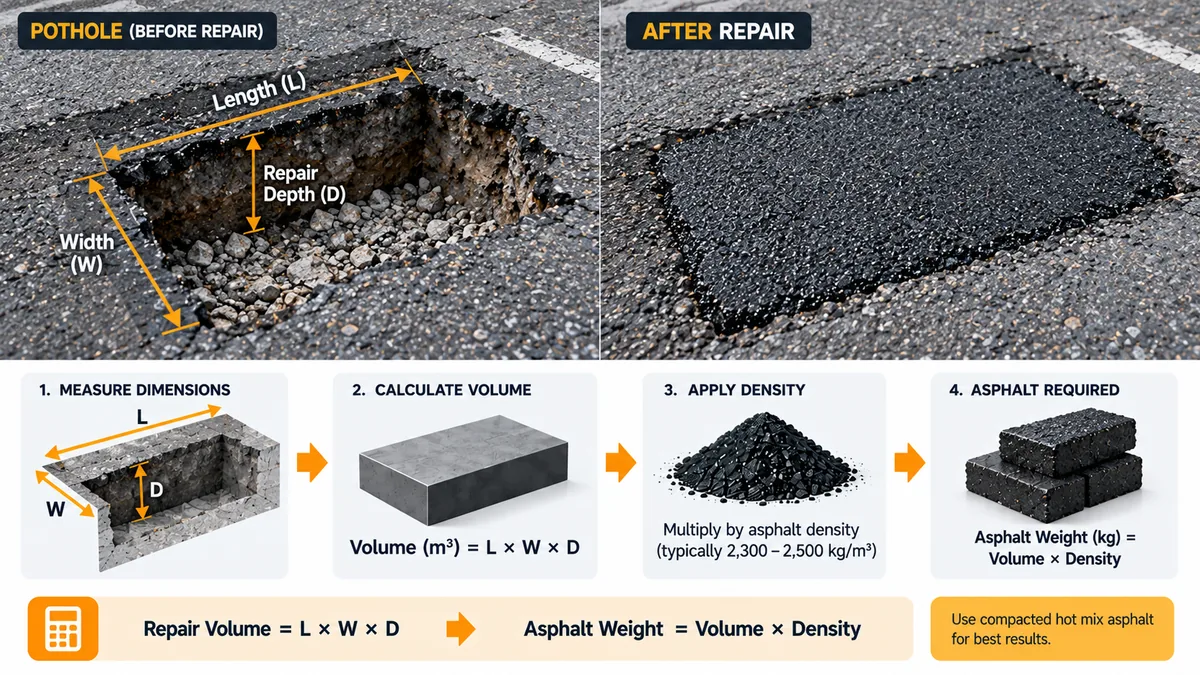
Throw-and-roll (cold-mix) is for temporary repairs. Remove-and-replace with hot-mix is the permanent solution. Saw-cutting edges ensures a clean bond.
Cold-mix: pre-bagged for emergency repairs, available year-round. Hot-mix: requires plant access, best for permanent repairs. UPM/all-weather mix for year-round use.
1 × 25 kg bag of cold-mix fills approximately 0.01–0.02 m³ (10–20 litres). For loose density ~1700 kg/m³, that's about 14 L per bag before compaction.
Repair Methods by Defect Type
Recommended repair approach based on pavement defect type and severity.
| Defect Type | Recommended Method | Material | Notes |
|---|---|---|---|
| Small pothole (<0.1 m²) | Throw-and-roll | Cold-mix | Temporary fix; replace when possible |
| Large pothole (>0.1 m²) | Remove & replace | Hot-mix HMA | Saw-cut edges for permanent repair |
| Edge cracking | Edge repair + overlay | Hot-mix HMA | Address drainage if applicable |
| Hairline cracks (<5mm) | Crack routing + sealing | Hot-pour sealant | Clean and dry before sealing |
| Wide cracks (>5mm) | Routing + backer rod + seal | Polyurethane/bitumen | Use backer rod for deep cracks |
| Alligator cracking | Full-depth reclamation | Recycled base + overlay | Structural failure — base problem |
Asphalt Repair Quantity Formulas
Each repair type uses a simple volume-to-weight conversion. The key variable is the repair depth — measure carefully after sawcutting for accurate material estimates.
Crack Fill: Volume (L) = Length (m) × Width (mm) ÷ 1000 × Depth (mm) ÷ 1000 × 1000
Area Repair: Weight (t) = Area (m²) × Depth (m) × Density (kg/m³) ÷ 1,000
Pothole Example
A saw-cut pothole 0.6 m × 0.6 m × 80 mm deep: 0.6 × 0.6 × 0.08 m × 2,300 kg/m³ = 66.2 kg. Add 20% compaction waste → order 80 kg (3.2 bags of 25 kg cold mix). For hot mix, a minimum plant batch of 0.5 t is typical — pool multiple potholes into one order.
Crack Fill Example
A 20 m crack, 10 mm wide and 15 mm deep: 20 × 0.010 × 0.015 = 0.003 m³ = 3 litres of bitumen sealant. Hot-pour crack sealant typically comes in 20 kg blocks that yield approximately 15–18 litres when melted. One block covers roughly 100 m of 10 mm crack.
Mill & Fill Example
A 50 m² failing pavement area milled to 60 mm and replaced with HMA: 50 m² × 0.06 m × 2,350 kg/m³ ÷ 1,000 = 7.05 tonnes. Add 10% → order 7.8 t. At $160/t = $1,248 material cost. Use the Cost Calculator for full project pricing.
Never measure a pothole before sawcutting. The actual repair volume is determined by the prepared, vertical-sided excavation — not the ragged edge of the original defect. Sawcutting adds 10–20% to the area but ensures the repair patch has vertical, clean-bonding edges that dramatically increase the repair's service life. Over-estimating by ordering extra material is far less costly than under-estimating and returning to site for a second load.
Who Uses an Asphalt Repair Calculator
From councils and road crews to property managers and DIY homeowners, repair calculators help anyone avoid over- or under-ordering patch material.
Municipal Road Crews
Council maintenance gangs use repair calculators to load trucks with the correct amount of cold or hot mix before heading out for pothole patrols. A typical urban pothole gang (2–3 workers, 1 truck) might repair 20–40 potholes per shift. Pre-calculating the total material load avoids mid-shift plant runs. Larger repair programmes (>50 t) warrant using the Tonnage Calculator and ordering from the plant directly.
Property & Facility Managers
Commercial property managers use repair calculators to estimate patch material quantities for car park and access road maintenance programmes. A 2,000 m² car park may accumulate 10–20 individual potholes per year, each averaging 0.5 m² × 60 mm deep ≈ 69 kg. Calculating each repair upfront enables accurate contractor quotes and budget approval. See the Cost Calculator for full project cost estimates.
Homeowners & DIY
Residential property owners use the pothole calculator to determine how many bags of cold mix to buy before visiting a hardware store. A typical driveway pothole 300 mm × 300 mm × 50 mm deep needs just 10–12 kg of compacted patch — one 25 kg bag is plenty. For larger driveway repairs (>1 m²), the calculator helps decide whether DIY cold mix or a professional hot mix repair is more economical. The calculator above handles all three repair types.
How to Use This Calculator
Select Repair Type
Choose the repair mode — Pothole Patch, Crack Fill, or Area Repair. Pothole patching uses full-depth or partial-depth cold or hot mix. Crack sealing uses liquid bitumen sealant and is measured by linear metres. Area repair (mill and fill) calculates based on area and milling depth.
Enter Repair Dimensions
For pothole patching, enter the length, width, and depth of the prepared pothole (saw-cut edges square). Typical pothole depth is 50–100 mm. For area repairs (mill and fill), enter the area and milling depth. Always measure the prepared excavation dimensions, not the original defect size.
Calculate Material Needed
Click Calculate to get total asphalt required in kg or tonnes for your repair. For small repairs, cold mix asphalt comes in 25 kg bags — the calculator will show how many bags to purchase. Add 10–20% extra for compaction and waste on small pothole repairs. Hot mix is more durable but requires minimum batch quantities from the plant.
For patching on a residential drive, where cost per square foot usually matters more than tonnage, see the driveway cost breakdown.
Frequently Asked Questions
How much asphalt do I need to fill a pothole?
For a typical pothole of 300 mm × 300 mm × 75 mm deep: Volume = 0.3 × 0.3 × 0.075 = 0.00675 m³. At 2350 kg/m³ = 15.9 kg of compacted asphalt. Add 20% for compaction loss = approximately 19 kg. A 25 kg bag of cold mix is sufficient for this size. Larger potholes over 1 m² are better addressed with hot mix from a professional contractor for lasting durability.
Cold mix vs hot mix for pothole repairs — which is better?
Hot mix asphalt (HMA) provides significantly more durable and long-lasting pothole repairs because the mix bonds well at high temperature and compacts properly. Cold mix is suitable for temporary or emergency repairs and small isolated potholes, especially in cold/wet conditions where HMA plants aren't operating. Cold mix bags are convenient for DIY use but typically last 1–3 years; hot mix repairs can last 8–15+ years when properly installed.
How do I prepare a pothole for patching?
For a lasting repair: (1) Saw-cut or mill the edges square to create a clean, vertical perimeter — remove all loose or cracked material. (2) Clean the hole of debris, water, and vegetation. (3) Apply a tack coat (emulsified bitumen) to the vertical edges and base. (4) Fill with hot or cold mix in maximum 75 mm lifts and compact each lift thoroughly. (5) The final surface should be slightly proud of the surrounding pavement, as asphalt will compact further under traffic.
What is alligator cracking and how is it repaired?
Alligator cracking (also called fatigue cracking) is a network of interconnected cracks resembling alligator skin. It indicates structural failure — the base or subbase has insufficient bearing capacity for the traffic load, and surface patching alone will not last. The correct repair is full-depth reclamation (FDR): remove all pavement layers, stabilise or replace the base material, and lay a new structural pavement. Applying a simple overlay or patch on alligator-cracked pavement typically fails within 1–2 years. For area repairs over alligator cracking, use the Area Repair tab above to calculate the full-depth replacement quantity.
How long does an asphalt pothole repair last?
Repair longevity depends heavily on the method and preparation: Throw-and-roll cold mix (no sawcutting, no compaction) — 3–12 months. Properly compacted cold mix with sawcut edges — 1–3 years. Hot mix HMA with sawcut edges, tack coat, and plate compactor — 5–15 years if the surrounding pavement is sound. The single biggest factor is edge preparation — a sawcut vertical edge bonds the patch to the surrounding pavement, while a ragged edge allows water ingress and accelerates re-failure. Compaction quality is the second most important factor.
Can I repair asphalt in cold or wet weather?
Cold mix asphalt (pre-mixed with solvent or emulsion) can be applied at temperatures down to about 2–4°C and in light rain, making it suitable for emergency winter repairs. However, performance is reduced in cold weather — the mix remains softer and compacts less effectively. Hot Mix Asphalt should not be placed when the ground temperature is below 5°C or when it is actively raining on the repair area, as these conditions prevent proper compaction and bonding. For critical hot mix repairs in cold weather, warming the substrate with a propane torch and working quickly to minimise heat loss improves results.
Sources
Default densities and binder contents on this page are taken from published references, not estimated. Check them against whatever governs your job.
- Asphalt Institute — technical resources and engineering bulletins
- Asphalt Institute, MS-2 Asphalt Mix Design Methods, 7th edition
- Caltrans, Construction Manual — Section 4-39, Asphalt Concrete
Reference values last reviewed in July 2026. Any cost figures quoted are indicative only and date quickly — treat them as a sanity check on a quote, never as a quote. See our editorial policy for how these values are sourced and reviewed, and the disclaimer for the limits of these estimates.