Asphalt Tonnage Calculator
Calculate exact asphalt mix weight, compacted volume, and bitumen binder takeoff from project dimensions and target mix density. Built for paving contractors, highway engineers, and estimators.
- Imperial: 1,000 sq ft at 2 inches compacted depth requires 12.1 US short tons (10.97 metric tonnes).
- Metric: 100 m² at 50 mm compacted depth requires 11.75 metric tonnes (12.95 US short tons).
Active Mathematical Formula
The calculator uses the following formula to determine asphalt volume and material quantities.
Estimation Results
Calculated material quantities based on your inputs.
BETTER
ROADS
(Length × Width)
(L × W × T)
(Assuming 5.5%)
(Assuming 5.5% binder)
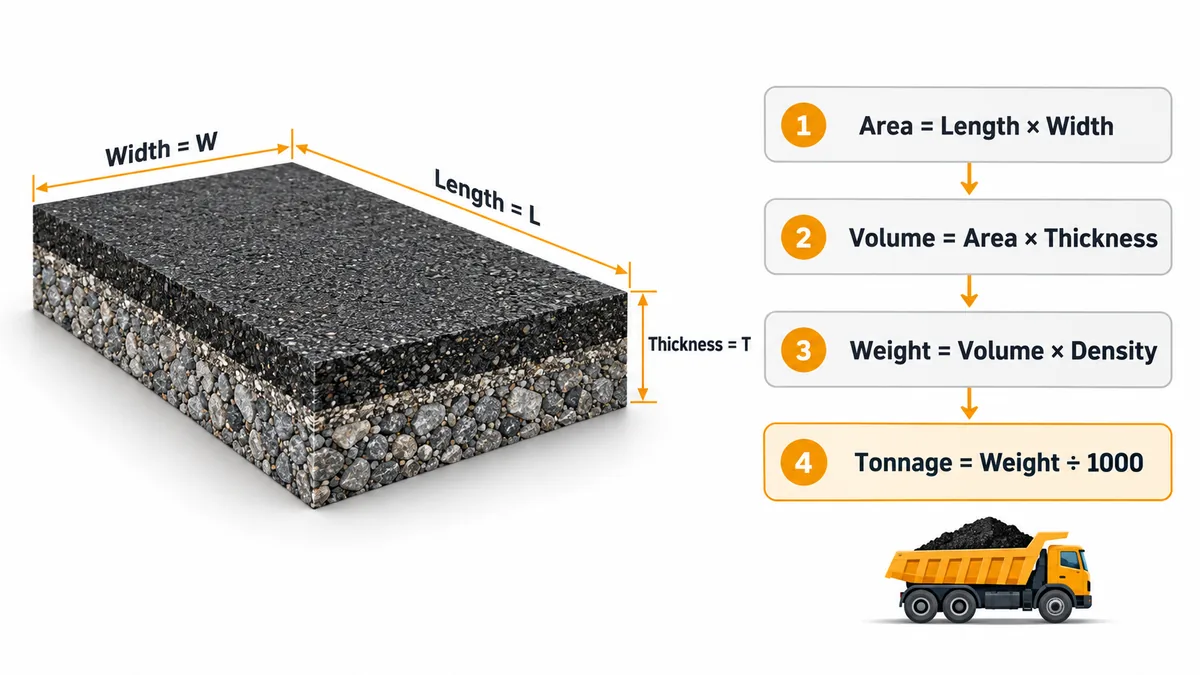
Tonnage is the total weight of asphalt mix required for your project. It equals compacted volume (area × thickness) multiplied by the mix bulk density.
Dense HMA: 2,300–2,400 kg/m³ (144–150 lb/ft³). SMA: 2,350–2,450 kg/m³. Porous/OGFC: 1,950–2,150 kg/m³. Use approved JMF values for tenders.
Always order 5–10% extra for compaction variations, cold joints, and paver transitions. Large highway jobs use 5%; small or curved driveways need 8–10%.
Tonnes per 100 m² at Various Lift Thicknesses
Quick reference matrix showing estimated mix tonnage at common field densities. Add 5–10% for jobsite allowance.
| Compacted Depth | 2,250 kg/m³ | 2,300 kg/m³ | 2,350 kg/m³ (Standard) | 2,400 kg/m³ (Dense) |
|---|---|---|---|---|
| 30 mm (1.2 in) Thin Overlay | 6.75 t | 6.90 t | 7.05 t | 7.20 t |
| 50 mm (2.0 in) Surface Course | 11.25 t | 11.50 t | 11.75 t | 12.00 t |
| 75 mm (3.0 in) Driveway / Light Commercial | 16.88 t | 17.25 t | 17.63 t | 18.00 t |
| 100 mm (4.0 in) Heavy Commercial / Binder | 22.50 t | 23.00 t | 23.50 t | 24.00 t |
| 150 mm (6.0 in) Heavy Highway Base Course | 33.75 t | 34.50 t | 35.25 t | 36.00 t |
The Asphalt Tonnage Formula Explained
Understanding the calculation helps you verify tender estimates and prevent costly plant re-delivery charges.
Calculate Volume
Multiply the paved area (length × width in metres) by the compacted layer thickness converted to metres. For example: a 200 m road, 7 m wide, at 75 mm (0.075 m) gives 200 × 7 × 0.075 = 105 m³.
Apply Bulk Density
Multiply volume by compacted density. Dense HMA is typically 2,350 kg/m³: 105 m³ × 2,350 kg/m³ = 246,750 kg. Divide by 1,000 to convert to 246.75 metric tonnes.
Add Site Allowance
Theoretical takeoff never accounts for transverse joints, paver hoppers, or minor grade variations. Add 5–10% extra: for 246.75 t, adding 7% means ordering 264 tonnes.
Total mix weight divides into pure bitumen binder and graded mineral aggregate. At 5.5% bitumen content: 246.75 t × 0.055 = 13.57 t of bitumen and 246.75 − 13.57 = 233.18 t of aggregate.
Where Asphalt Tonnage Calculations Are Used
Precise tonnage estimating coordinates asphalt plant batching, trucking rosters, and paving crew shifts.
Roads & Highways
State and municipal highway projects require precise tonnage schedules. A standard two-lane road (7 m wide, 50 mm surface + 100 mm binder over 1 km) requires 350–400 tonnes per lift.
Open Road Calculator →Driveways & Parking Lots
Residential driveways use 40–50 mm of compacted HMA. A double driveway (6 m × 12 m = 72 m²) requires approx 8.5 tonnes. Heavy truck parking lots use 75–100 mm depth.
Open Cost Calculator →Pothole & Patching Works
Maintenance crews use tonnage calculations to load trucks accurately. A 2 m × 2 m pothole at 80 mm depth requires roughly 0.75 tonnes of hot or cold patch mix.
Open Repair Calculator →Related Bitumen & Asphalt Tools
Use our dedicated engineering tools for multi-layer road takeoffs, project budgets, and layer depth design.
How to Use This Calculator
Enter Area & Lift Thickness
Enter the length and width of your paved section, plus the compacted layer depth. Use metres and mm for metric projects, or toggle to feet and inches for US imperial estimates.
Select Mix Type & Density
Choose your asphalt specification to load standard densities: Dense HMA (2,300–2,400 kg/m³), OGFC (1,950–2,100 kg/m³), or SMA (2,350–2,450 kg/m³). Override with your lab JMF if known.
Review Tonnage & Truckloads
Review total mix weight in tonnes and US short tons, plus component binder and aggregate weights. Check the Order Planning box to calculate truckloads based on legal payload limits.
For deeper technical background, read our engineering guides: The Complete Asphalt Tonnage Guide for detailed density unit factors and wastage calculations, and How Much Asphalt Do I Need? for residential driveway sizing.
Frequently Asked Questions
What is the difference between tonnes and short tons in asphalt?
A metric tonne equals 1,000 kg (2,204.6 lbs). A US short ton equals 2,000 lbs (907 kg). Asphalt suppliers in the US typically quote in short tons, while most of the rest of the world (including Australia, UK, and Canada) use metric tonnes. The difference is about 10%: 1 metric tonne = 1.102 short tons. Always confirm which unit your supplier is quoting in to avoid costly ordering errors.
What density should I use to calculate asphalt tonnage?
Standard Hot Mix Asphalt (HMA/dense-graded) has a compacted density of approximately 2,300–2,400 kg/m³, commonly estimated at 2,350 kg/m³. Stone Matrix Asphalt (SMA) is slightly heavier at 2,300–2,380 kg/m³. Open-graded mixes are lighter at 1,950–2,100 kg/m³. For the most accurate results, use the actual density from your project's mix design or the plant's mix design report.
How many tonnes of asphalt per square metre?
For a 50 mm (2-inch) thick compacted HMA layer at 2,350 kg/m³: 0.05 m × 2,350 kg/m³ = 117.5 kg/m² = 0.1175 tonnes/m². A 100 m² area at 50 mm thickness requires approximately 11.75 tonnes. For a 25 mm (1-inch) layer, halve that to 5.875 tonnes. Our calculator handles this automatically — just enter your dimensions and density.
Should I add a waste factor to my asphalt tonnage calculation?
Yes. Always add a waste/overage factor when ordering asphalt. For straightforward machine-laid rectangular areas, add 5–8%. For irregular shapes, hand-work areas, driveways with curves, or projects with multiple thin lifts, use 10–15%. Material left in trucks (truck tare), cold joints, and compaction density variation also contribute to waste. It's better to have a small surplus than to run short and wait for a second delivery.
How many tonnes of asphalt do I need for a driveway?
For a typical residential driveway, a 50 mm compacted HMA layer at 2,350 kg/m³ requires approximately 0.1175 tonnes per m². A single-car driveway of 3 m × 10 m (30 m²) needs around 3.5 tonnes. A double driveway of 6 m × 12 m (72 m²) needs approximately 8.5 tonnes. Add 10% for edges and waste, giving a final order of around 9.5 tonnes. Use our Square Feet Calculator if you measured in imperial units.
How do I convert square metres to tonnes of asphalt?
Multiply the area in m² by the thickness in metres, then by the density in kg/m³, then divide by 1,000 to get tonnes. For example: 500 m² × 0.05 m (50 mm) × 2,350 kg/m³ ÷ 1,000 = 58.75 tonnes. If you only know the area in square metres and need a quick estimate, a rule of thumb for 50 mm HMA is approximately 0.12 t/m². Our Square Metres Calculator automates this conversion.
What bitumen content percentage should I use?
Standard Hot Mix Asphalt (HMA) contains approximately 4.5–6.5% bitumen binder by total mix weight. Surface course mixes tend towards the higher end (5.5–6.5%) for durability and waterproofing, while base course mixes may be lower (4–5%). Stone Mastic Asphalt (SMA) uses 6–7.5% due to its gap-graded aggregate skeleton requiring more binder to fill voids. Always use the bitumen content from your approved mix design rather than a default estimate for procurement calculations.
Industry Sources & Literature
Default densities and binder contents on BitumenCalc are sourced from published international standards.
- Asphalt Institute, MS-2 Asphalt Mix Design Methods, 7th edition
- ASTM D2041/D2041M-19 — Theoretical Maximum Specific Gravity and Density of Asphalt Mixtures (Rice test)
- ASTM D2726/D2726M-21 — Bulk Specific Gravity and Density of Compacted Asphalt Mixtures
- AASHTO Materials Standards (T 166, T 209 and related volumetric methods)
Reference values last reviewed in September 2026. Any cost estimates are indicative benchmarks and date quickly — always treat them as estimating checks, not final quotes. See our editorial policy for testing methodology and disclaimer for calculation limitations.
Asphalt tonnage from area, thickness and density
For a specified finished layer, multiply area by compacted thickness and mix density. At 2,400 kg/m³, 100 m² at 50 mm needs 12 metric tonnes before allowance. The main result is metric tonnes, with US short tons identified separately.
If your takeoff starts with volume, see tons of asphalt per cubic yard. Read the density guide for unit conversions and the thickness guide for separate lift calculations.
Need a Multi-Layer Road Takeoff?
Estimate surface, binder, and base courses simultaneously with custom lift densities and layer costs.
Launch Road Asphalt Calculator →