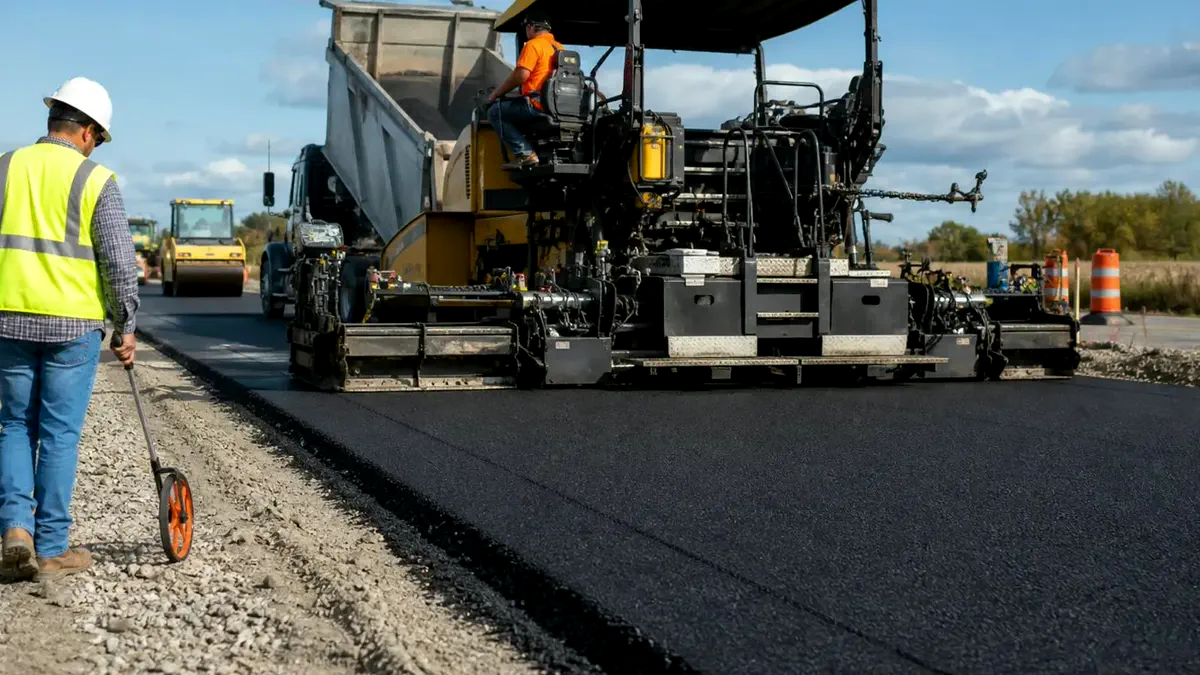
Estimating asphalt tonnage sounds simple.
Measure the area. Choose the thickness. Multiply by density. Convert the result into tons.
But in real projects, small mistakes become expensive very quickly. A driveway, road patch, parking lot, or resurfacing job can easily go over budget if the asphalt quantity is wrong. Order too little and the paving crew may stop halfway. Order too much and you pay for material that sits unused.
That is why an asphalt tonnage calculator is useful.
It turns project measurements into a fast material estimate. You enter the length, width, compacted depth, and density. The calculator gives you the estimated asphalt volume and total tons.
This guide explains the full method in a simple way. You will learn the asphalt tonnage formula, the correct unit conversions, example calculations, density values, waste factor, and common mistakes to avoid.
For quick results, you can also use the BitumenCalc asphalt tonnage calculator to calculate tons instantly.
Quick Answer: How Do You Calculate Asphalt Tonnage?
To calculate asphalt tonnage, first calculate the compacted asphalt volume. Then multiply the volume by asphalt density.
Basic formula:
For metric projects:
For imperial projects, you can calculate cubic feet first and then convert to tons using asphalt density in lb/ft³.
Most compacted asphalt mixes have a density around 2,300 to 2,450 kg/m³, depending on mix type, aggregate gradation, air voids, and compaction.
| Step | What to Do | Example |
|---|---|---|
| 1 | Measure length | 50 m |
| 2 | Measure width | 6 m |
| 3 | Convert thickness to meters | 50 mm = 0.05 m |
| 4 | Calculate volume | 50 × 6 × 0.05 = 15 m³ |
| 5 | Multiply by density | 15 × 2,350 = 35,250 kg |
| 6 | Convert to tons | 35,250 ÷ 1000 = 35.25 tonnes |
So, a 50 m × 6 m area with 50 mm compacted asphalt thickness needs about 35.25 metric tonnes of asphalt before adding waste.
What Is an Asphalt Tonnage Calculator?
An asphalt tonnage calculator is a tool that estimates how many tons of asphalt are needed for a paving project.
It usually uses four main inputs:
- Length of the paved area
- Width of the paved area
- Compacted asphalt thickness
- Asphalt mix density
Some calculators also include cost per ton, waste percentage, currency, and mix type.
On BitumenCalc, the calculator system is built for asphalt and bitumen estimation. It supports dimensions, unit conversions, density values, bitumen percentage, aggregate quantity, and cost calculation for different project types. The site also includes related calculators for material, cost, road quantity, tack coat, roofing, repair, removal, and regional asphalt estimation.
That makes it useful for:
- Driveways
- Road construction
- Parking lots
- Asphalt overlays
- Pothole repairs
- Industrial yards
- Footpaths
- Residential paving
- Commercial paving
- Small civil estimation jobs
The main purpose is simple: convert area and thickness into asphalt weight.
Why Asphalt Is Ordered by Ton, Not Only by Area
Many people measure paving projects in square meters or square feet.
That is fine for area.
But asphalt is usually purchased, transported, and billed by weight. Contractors, asphalt plants, truck drivers, and project estimators normally deal with tons or tonnes.
Area alone is not enough because thickness changes everything.
For example, both projects below have the same area:
| Project | Area | Thickness | Approx. Asphalt Needed |
|---|---|---|---|
| Thin overlay | 100 m² | 30 mm | 6.9 tonnes |
| Heavy-duty surface | 100 m² | 75 mm | 17.25 tonnes |
Same area.
Very different tonnage.
That is why thickness is one of the most important inputs in any asphalt calculator.
A 100 m² driveway at 40 mm does not need the same asphalt as a 100 m² parking area at 75 mm. The thicker the pavement layer, the more asphalt you need.
Asphalt Tonnage Formula Explained
The asphalt tonnage formula has three main parts.
1. Area
Area is calculated by multiplying length by width.
Example:
2. Volume
Volume is calculated by multiplying area by compacted thickness.
If the thickness is given in millimeters, convert it to meters first.
Example:
3. Weight
Weight is calculated by multiplying volume by asphalt density.
Example:
Then convert kilograms to metric tonnes:
So, the final result is 11.75 tonnes of asphalt.
Metric Asphalt Tonnage Formula
For metric measurements, use this formula:
Example: Road Section Calculation
Let’s say you need asphalt for a small road section.
| Input | Value |
|---|---|
| Length | 120 m |
| Width | 4 m |
| Thickness | 60 mm |
| Density | 2,350 kg/m³ |
Convert thickness:
Calculate volume:
Calculate weight:
Convert to tonnes:
So this road section needs about 67.68 tonnes of asphalt.
If you add 5% waste:
Final order estimate: about 71 tonnes.
Imperial Asphalt Tonnage Formula
For imperial measurements, use feet and inches.
First convert asphalt thickness from inches to feet:
Then use this formula:
A common compacted asphalt density is around 145 lb/ft³, but the exact value can vary by mix.
Example: Driveway Calculation in Feet
| Input | Value |
|---|---|
| Length | 60 ft |
| Width | 12 ft |
| Thickness | 2 in |
| Density | 145 lb/ft³ |
Convert thickness:
Calculate volume:
Calculate weight:
Convert to short tons:
So the driveway needs about 8.72 short tons of asphalt before waste.
With 5% extra:
Final order estimate: about 9.2 short tons.
Asphalt Density: What Value Should You Use?
Density is the weight of asphalt per unit of volume.
It is usually written as:
- kg/m³ in metric calculations
- t/m³ for quick metric estimates
- lb/ft³ in imperial calculations
Different asphalt mixes have different densities. Dense-graded asphalt is heavier than porous asphalt because it has fewer air voids. Open-graded and porous mixes are lighter because they are designed with more void space for drainage or noise reduction.
Here is a practical reference table.
| Asphalt Mix Type | Typical Density kg/m³ | Typical Density t/m³ | Common Use |
|---|---|---|---|
| Dense-graded asphalt | 2,300–2,450 | 2.30–2.45 | Roads, driveways, parking lots |
| Stone mastic asphalt | 2,250–2,380 | 2.25–2.38 | High-traffic roads |
| Warm mix asphalt | 2,280–2,400 | 2.28–2.40 | Lower-temperature paving |
| Recycled asphalt mix | 2,200–2,350 | 2.20–2.35 | Overlays, rehabilitation |
| Cold mix asphalt | 2,100–2,300 | 2.10–2.30 | Repairs, temporary patching |
| Porous asphalt | 1,800–2,100 | 1.80–2.10 | Drainage pavement |
| Open-graded friction course | 1,900–2,150 | 1.90–2.15 | Surface drainage, noise reduction |
For general estimating, many contractors use 2.35 t/m³ or 2,350 kg/m³ for compacted dense asphalt.
But for final ordering, always use the density from your asphalt plant, mix design, project specification, or laboratory result.
Asphalt Thickness Conversion Table
Thickness must be converted correctly before calculating volume.
Many wrong tonnage estimates happen because thickness is entered in millimeters but treated as meters, or inches are not converted to feet.
Use this table for quick conversion.
| Thickness | Meters | Feet | Common Use |
|---|---|---|---|
| 25 mm / 1 in | 0.025 m | 0.083 ft | Very thin overlay or leveling |
| 40 mm / 1.5 in | 0.040 m | 0.125 ft | Light wearing course |
| 50 mm / 2 in | 0.050 m | 0.167 ft | Driveway surface layer |
| 60 mm / 2.4 in | 0.060 m | 0.197 ft | Road surface or commercial area |
| 75 mm / 3 in | 0.075 m | 0.250 ft | Parking lot or binder layer |
| 100 mm / 4 in | 0.100 m | 0.333 ft | Base course or heavier pavement |
| 150 mm / 6 in | 0.150 m | 0.500 ft | Heavy-duty pavement structure |
A small thickness error can change the asphalt order by several tons.
For example, using 50 mm instead of 40 mm increases asphalt quantity by 25%.
That is a big difference.
Asphalt Tons per Square Meter
Sometimes you already know the area and thickness, and you only need a quick tons-per-square-meter estimate.
Assuming compacted asphalt density of 2,300 kg/m³, the approximate asphalt quantity is:
| Compacted Thickness | Tonnes per m² | Tonnes per 100 m² |
|---|---|---|
| 25 mm | 0.0575 | 5.75 |
| 30 mm | 0.0690 | 6.90 |
| 40 mm | 0.0920 | 9.20 |
| 50 mm | 0.1150 | 11.50 |
| 60 mm | 0.1380 | 13.80 |
| 75 mm | 0.1725 | 17.25 |
| 100 mm | 0.2300 | 23.00 |
This table is useful for fast estimates.
But if your asphalt density is different, the final tonnage will also change.
For accurate results, use a calculator that allows custom density input.
Asphalt Tons per Square Foot
For imperial projects, many users want to know how many tons of asphalt are needed per square foot.
Assuming asphalt density of 145 lb/ft³, the approximate quantity is:
| Compacted Thickness | Short Tons per ft² | Short Tons per 1,000 ft² |
|---|---|---|
| 1 in | 0.0060 | 6.04 |
| 1.5 in | 0.0091 | 9.06 |
| 2 in | 0.0121 | 12.08 |
| 3 in | 0.0181 | 18.13 |
| 4 in | 0.0242 | 24.17 |
| 6 in | 0.0363 | 36.25 |
This is helpful for driveways, small parking areas, and resurfacing work.
Example:
If your driveway is 1,000 ft² and asphalt thickness is 2 inches, you need about 12.08 short tons before adding waste.
How Many Tons Are in One Cubic Meter of Asphalt?
One cubic meter of compacted asphalt usually weighs about 2.3 to 2.45 metric tonnes.
The exact value depends on density.
| Asphalt Density | Weight of 1 m³ |
|---|---|
| 2,100 kg/m³ | 2.10 tonnes |
| 2,200 kg/m³ | 2.20 tonnes |
| 2,300 kg/m³ | 2.30 tonnes |
| 2,350 kg/m³ | 2.35 tonnes |
| 2,400 kg/m³ | 2.40 tonnes |
| 2,450 kg/m³ | 2.45 tonnes |
So if you know the asphalt volume in cubic meters, multiply it by the density in tonnes per cubic meter.
Example:
How Many Tons Are in One Cubic Yard of Asphalt?
In imperial projects, one cubic yard of compacted asphalt is commonly estimated around 1.95 to 2.05 short tons, depending on density.
Using 145 lb/ft³:
So, a practical estimate is:
| Cubic Yards | Approx. Short Tons |
|---|---|
| 1 | 1.96 |
| 2 | 3.92 |
| 5 | 9.80 |
| 10 | 19.60 |
| 20 | 39.20 |
| 50 | 98.00 |
This conversion is useful when your project volume is already calculated in cubic yards.
Should You Add Waste Factor to Asphalt Tonnage?
Yes, usually.
The calculator gives a mathematical estimate based on compacted volume and density. Real job sites are not perfectly clean.
You may lose material due to:
- Truck unloading
- Spreading and raking
- Irregular edges
- Low spots
- Handwork around drains or kerbs
- Compaction variation
- Measurement errors
- Small changes in paving thickness
For most projects, a 5% to 10% waste factor is practical.
| Project Type | Suggested Waste Factor |
|---|---|
| Simple rectangular driveway | 5% |
| Regular parking lot | 5%–7% |
| Road overlay | 5%–8% |
| Irregular paving area | 8%–10% |
| Patching and repair work | 10% or more |
Formula:
Example:
In my opinion, it is better to add a small waste allowance than to stop the crew because the material finished early.
However, do not add too much waste blindly. Asphalt is expensive, and unused hot mix may not be easy to return.
Worked Example 1: Small Residential Driveway
Let’s calculate asphalt for a residential driveway.
| Input | Value |
|---|---|
| Length | 18 m |
| Width | 4 m |
| Thickness | 50 mm |
| Density | 2,350 kg/m³ |
| Waste | 5% |
Step 1: Convert thickness.
Step 2: Calculate area.
Step 3: Calculate volume.
Step 4: Calculate weight.
Step 5: Convert to tonnes.
Step 6: Add waste.
Final estimate: about 8.9 tonnes of asphalt.
Worked Example 2: Parking Lot Asphalt Tonnage
Now let’s calculate asphalt for a parking lot.
| Input | Value |
|---|---|
| Length | 70 m |
| Width | 35 m |
| Thickness | 75 mm |
| Density | 2,350 kg/m³ |
| Waste | 7% |
Step 1: Area.
Step 2: Convert thickness.
Step 3: Volume.
Step 4: Weight.
Step 5: Convert to tonnes.
Step 6: Add waste.
Final estimate: about 462 tonnes of asphalt.
For a project like this, you should confirm the pavement design, layer structure, and asphalt plant mix density before ordering.
Worked Example 3: Asphalt Overlay Calculation
An asphalt overlay is a new layer placed over an existing surface.
Let’s say you need a 40 mm overlay on an existing road.
| Input | Value |
|---|---|
| Length | 300 m |
| Width | 7 m |
| Thickness | 40 mm |
| Density | 2,300 kg/m³ |
| Waste | 5% |
Area:
Thickness:
Volume:
Weight:
Tonnes:
With waste:
Final estimate: about 203 tonnes of asphalt.
Common Asphalt Tonnage Mistakes
Asphalt estimation is mostly simple math, but the same mistakes happen again and again.
Here are the most common ones.
| Mistake | Why It Matters | How to Fix It |
|---|---|---|
| Using mm as meters | Makes quantity 1,000 times wrong | Convert 50 mm to 0.05 m |
| Forgetting compacted thickness | Loose depth and compacted depth are not always the same | Use final compacted layer thickness |
| Ignoring density | Different mixes have different weights | Use project mix density |
| No waste factor | May cause shortage on site | Add 5%–10% depending on job |
| Using area only | Area does not include thickness | Always calculate volume first |
| Mixing metric and imperial units | Causes conversion errors | Keep one unit system throughout |
| Not separating layers | Base, binder, and surface may have different thickness | Calculate each layer separately |
The safest method is to calculate each pavement layer separately and then add the totals.
For example:
- Base course: 100 mm
- Binder course: 60 mm
- Wearing course: 40 mm
Each layer may use a different density and mix type.
How to Calculate Asphalt for Multiple Layers
Some pavement projects are not one single asphalt layer.
A road or parking lot may include:
- Asphalt base course
- Binder course
- Wearing course
- Surface overlay
If the layers have different thicknesses or mixes, calculate them separately.
Example: Two-Layer Pavement
Project area: 500 m²
| Layer | Thickness | Density |
|---|---|---|
| Binder course | 60 mm | 2,350 kg/m³ |
| Wearing course | 40 mm | 2,300 kg/m³ |
Binder course:
Wearing course:
Total:
With 5% waste:
Final estimate: about 122 tonnes.
This method is more accurate than combining all layers into one average thickness.
Asphalt Cost from Tonnage
Once you know asphalt tonnage, cost calculation becomes easier.
Basic formula:
Example:
But material cost is not the full project cost.
A real paving estimate may also include:
- Plant material price
- Trucking and delivery
- Labour
- Equipment
- Tack coat or prime coat
- Milling or removal
- Base preparation
- Compaction
- Traffic control
- Profit margin
- Taxes
So the asphalt tonnage calculator is the first step. A full cost estimate needs more project details.
You can use the BitumenCalc cost calculator if you want to estimate asphalt cost by tonnage and unit price.
Asphalt Tonnage Calculator Inputs: What You Need Before Starting
Before using an asphalt calculator, collect the right measurements.
| Input | Best Practice |
|---|---|
| Length | Measure the actual paving length, not only the property size |
| Width | Use average width for irregular areas |
| Thickness | Use compacted thickness from the design |
| Density | Use the asphalt plant or specification value |
| Waste factor | Add 5%–10% based on project shape |
| Unit price | Use current supplier price per ton |
If the area is irregular, break it into smaller rectangles.
Example:
- Section 1: 20 m × 5 m
- Section 2: 12 m × 4 m
- Section 3: 8 m × 3 m
Calculate each area separately, then add them.
This is much more accurate than guessing one large shape.
Manual Calculation vs Asphalt Tonnage Calculator
Manual calculation is good because it helps you understand the formula.
But for daily work, a calculator is faster.
| Method | Best For | Limitation |
|---|---|---|
| Manual formula | Learning, checking, small estimates | Easy to make unit mistakes |
| Spreadsheet | Repeated project estimates | Needs setup and formulas |
| Online calculator | Fast quantity checks | Must enter correct values |
| Engineer estimate | Final project design | Takes more time and project data |
The best approach is to use both.
Understand the formula, then use a calculator to save time.
That way, you can quickly notice if the result looks wrong.
Best Internal Calculators to Use on BitumenCalc
BitumenCalc has several tools that support asphalt estimation.
Use the right calculator depending on the job.
| Calculator | Use It For |
|---|---|
| Tonnage Calculator | Convert length, width, thickness, and density into tons |
| Cost Calculator | Estimate asphalt material cost from tonnage and price |
| Material Calculator | Calculate bitumen, aggregate, and total mix quantities |
| Road Calculator | Estimate road paving material quantities |
| Thickness Calculator | Work with pavement layer depth and coverage |
| Sq Ft to Tons Calculator | Convert square feet and depth into asphalt tons |
| Millings Calculator | Estimate recycled asphalt or RAP quantities |
If you are not sure where to start, use the tonnage calculator first.
It gives the most important number: total asphalt tons.
Practical Tips for More Accurate Asphalt Tonnage
Here are some simple field tips that improve your estimate.
- Measure in more than one place if the area is irregular.
- Use compacted thickness, not loose material thickness.
- Confirm asphalt density with the supplier.
- Separate different pavement layers.
- Add waste factor for edges, low spots, and handwork.
- Round final order quantities sensibly.
- Check truck capacity before scheduling delivery.
- Do not use one density value for all special mixes.
- Recheck unit conversions before ordering.
- Use a calculator for final checking.
A good estimate is not only about math.
It is about using realistic site measurements.
Even the best calculator will give the wrong result if the input values are wrong.
Asphalt Tonnage Cheat Sheet
Here is a simple cheat sheet for quick estimation.
| Question | Quick Answer |
|---|---|
| How do I calculate asphalt tons? | Length × width × thickness × density |
| What density should I use? | Around 2,300–2,450 kg/m³ for dense asphalt |
| How many tonnes in 1 m³ asphalt? | About 2.3–2.45 tonnes |
| How many short tons in 1 yd³ asphalt? | About 1.96 short tons |
| Should I add waste? | Yes, usually 5%–10% |
| Is asphalt ordered by area? | Usually no, it is commonly ordered by weight |
| Does thickness matter? | Yes, it directly changes tonnage |
| Can I calculate multiple layers? | Yes, calculate each layer separately |
Final Thoughts
An asphalt tonnage calculator helps you estimate paving material quickly and avoid costly mistakes.
The basic formula is simple:
But the accuracy depends on your inputs.
The most important details are compacted thickness, correct unit conversion, realistic density, and a practical waste allowance.
For a small driveway, a rough estimate may be enough for budgeting. For a road, parking lot, or commercial paving project, you should use project-specific density, layer thickness, and mix design values.
To save time, use the BitumenCalc asphalt tonnage calculator and check your quantity in seconds.
It is faster than manual math and reduces the chance of unit conversion errors.
FAQs About Asphalt Tonnage Calculator
What is an asphalt tonnage calculator?
An asphalt tonnage calculator estimates how many tons of asphalt are needed for a paving project. It uses length, width, compacted thickness, and asphalt density to calculate volume and weight.
What is the formula for asphalt tonnage?
The metric formula is:
For imperial measurements:
What density should I use for asphalt?
For general dense-graded asphalt, use around 2,300 to 2,450 kg/m³. A common estimating value is 2,350 kg/m³. For final ordering, use the density from your supplier, mix design, or project specification.
How many tonnes are in one cubic meter of asphalt?
One cubic meter of compacted asphalt usually weighs about 2.3 to 2.45 metric tonnes, depending on density and mix type.
How many tons are in one cubic yard of asphalt?
One cubic yard of compacted asphalt is commonly around 1.95 to 2.05 short tons. Using 145 lb/ft³, one cubic yard equals about 1.96 short tons.
How much asphalt do I need for 100 square meters?
It depends on thickness. At 50 mm compacted thickness and 2,300 kg/m³ density, 100 m² needs about 11.5 tonnes of asphalt before waste.
How much asphalt do I need for 1,000 square feet?
At 2 inches thick and 145 lb/ft³ density, 1,000 ft² needs about 12.08 short tons of asphalt before waste.
Should I add waste to asphalt tonnage?
Yes. A 5% to 10% waste factor is common depending on the project shape, edges, low spots, handwork, and site conditions.
Is asphalt calculated before or after compaction?
Asphalt tonnage is usually estimated based on compacted in-place thickness. Make sure the thickness you enter into the calculator is the final compacted thickness.
Can I use the same formula for driveways and roads?
Yes. The same formula works for driveways, roads, parking lots, and overlays. The main difference is the design thickness, asphalt mix type, density, and waste factor.
Can I calculate asphalt cost from tonnage?
Yes. Multiply asphalt tons by price per ton. For example, 40 tonnes at 90 per tonne equals 3,600 material cost. Remember that full paving cost may also include delivery, labour, equipment, tack coat, base preparation, and taxes.
What is the easiest way to calculate asphalt tons?
The easiest way is to use an online asphalt tonnage calculator. Enter the length, width, thickness, and density, then the calculator converts the project into tons instantly.