Road Asphalt Calculator
Estimate asphalt tonnage, bitumen quantity, and cost for road and highway projects using lane width, length, thickness and layer details.
Active Mathematical Formula
Calculates multi-course pavement takeoff across surface, binder, and base layers.
Roadway Takeoff
Layer breakdown & material schedule.
BETTER
ROADS
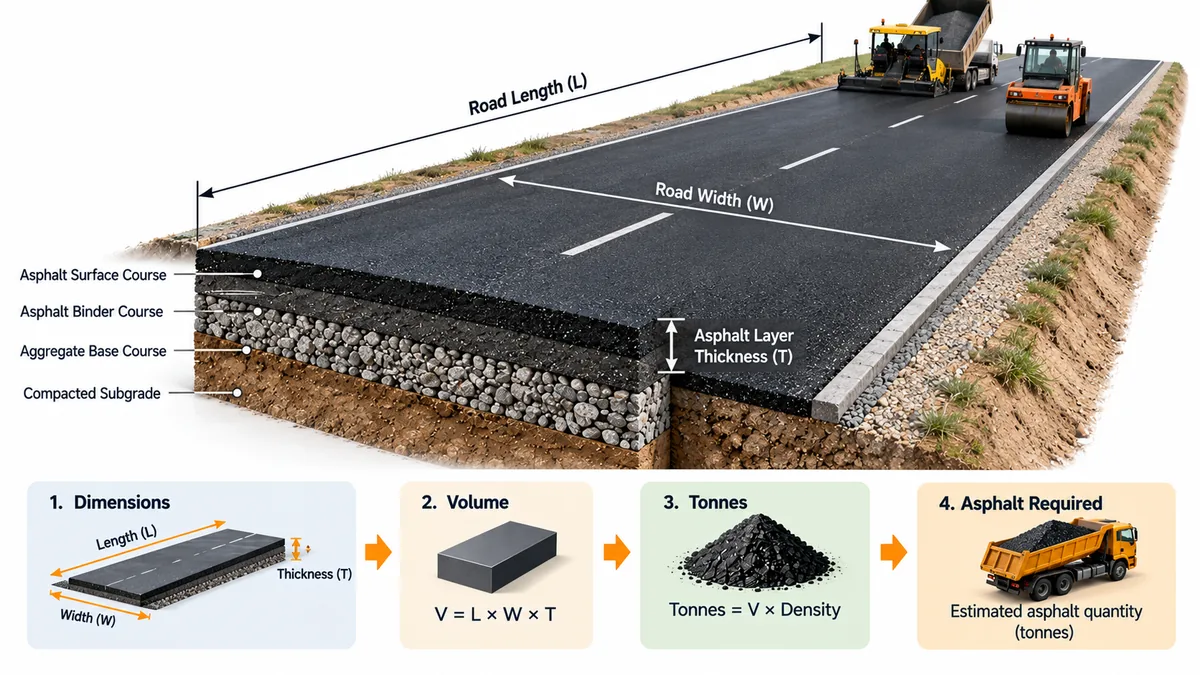
Most roads have 3+ layers: surface (wearing) course, binder (intermediate) course, and base course. Each is calculated and costed separately.
Highway lanes: 3.5–3.7 m. Urban arterials: 3.0–3.5 m. Rural sealed roads: 3.0–3.5 m per lane. Turning lanes often narrower at 2.75–3.0 m.
Surface course: 40–75 mm. Binder course: 50–100 mm. Base course: 100–200 mm. Totals range from 150 mm (local) to 375+ mm (motorway).
Typical Road Layer Specifications
Standard layer thicknesses by road classification. Values are guidelines — consult local standards for design requirements.
| Road Class | Surface Course | Binder Course | Base Course | Total HMA |
|---|---|---|---|---|
| Motorway / Freeway | 50–75 mm | 75–100 mm | 150–200 mm | 275–375 mm |
| Primary Arterial | 50–60 mm | 60–80 mm | 100–150 mm | 210–290 mm |
| Secondary Road | 40–50 mm | 50–75 mm | 100–125 mm | 190–250 mm |
| Local Residential | 30–50 mm | — | 75–100 mm | 105–150 mm |
| Industrial / Heavy | 60–75 mm | 75–100 mm | 150–200 mm | 285–375 mm |
Road Asphalt Calculation Formula
Road asphalt is calculated layer by layer. Each course (surface, binder, base) has its own thickness and possibly a different mix density — they are summed to give total project tonnage.
Worked Example — 2km Urban Arterial
2-lane urban arterial, 2 km long, 7.4 m wide (2 × 3.7 m lanes), at 2,350 kg/m³ for all layers. Surface course 50 mm: 2,000 × 7.4 × 50 ÷ 1,000 × 2,350 ÷ 1,000 = 1,739 t. Binder course 75 mm: 2,609 t. Base course 100 mm: 3,478 t. Total all layers: 7,826 tonnes. At A$200/t = A$1.57 million in asphalt material alone.
Total Width Calculation
Total paved width = (Number of lanes × Lane width) + (Shoulder width × 2 sides). For a 2-lane highway with 3.6 m lanes and 2.0 m shoulders: Total width = (2 × 3.6) + (2.0 × 2) = 7.2 + 4.0 = 11.2 m. Shoulders may use a different (thinner) pavement structure than the trafficked lanes — if so, calculate them separately. Medians between opposing carriageways are excluded unless paved.
Tonnes Per Lane-km Reference
A useful planning benchmark: surface course = approximately 115–175 t/lane-km (50–75 mm at 2,300 kg/m³, 3.5 m lane). Binder course = approximately 140–230 t/lane-km (60–100 mm). Base course = approximately 230–460 t/lane-km (100–200 mm). Multi-lane projects scale linearly. For exact procurement quantities, use the calculator with your confirmed design thicknesses and certified mix density. For regional US tonnage calculations, see the Square Yards Calculator.
Different pavement layers are often supplied by different plants or at different times during construction. Calculate each layer separately to enable separate procurement scheduling. The base course is typically placed first (and may have a different mix specification), followed by binder course, then surface course. Tack coat is required between layers — use the Tack Coat Calculator to estimate emulsion quantities for inter-layer bonding.
Where the Road Asphalt Calculator Is Used
From tender quantity estimates to construction project management — road paving calculation is one of the most critical quantity estimation tasks in civil infrastructure.
Tender Preparation & BOQ Estimation
Civil estimators preparing tenders for road paving contracts use this calculator to build the asphalt quantity component of their bill of quantities. Contract documents specify road length, width, and layer thicknesses — entering these dimensions produces the layer-by-layer tonnage required to populate the Schedule of Prices. For multi-million dollar highway contracts, a 1% error in asphalt quantity translates directly to contract profit or loss, making accurate tonnage calculation essential at bid stage.
Related: Asphalt Cost Calculator
Local Government & Council Road Programmes
Municipal engineers managing annual road rehabilitation and resurfacing programmes use road-length-based calculations to budget and schedule projects. Entering the annual programme of resurfacing lengths produces total tonnage needs for the year — enabling advance procurement and plant scheduling negotiations with asphalt suppliers. Councils with pavement management systems (PMS) typically carry out mass quantity calculations using this approach to convert from lane-km resurfacing needs to annual asphalt procurement budgets.
Related: Asphalt Tonnage Calculator
New Subdivision Road Construction
Property developers constructing new residential subdivision roads need to quantify asphalt for council adoption handover. Subdivision roads must be built to the local council's road specification — typically a full-depth design with base course, binder course, and wearing course. This calculator handles the multi-layer design for any road length and lane configuration. Combine the road tonnage with roundabout and cul-de-sac tonnage from the Circular Calculator for the total subdivision asphalt order.
Related: Circular Asphalt Calculator
How to Use This Calculator
Enter Road Dimensions
Enter the road length, number of lanes, lane width, and optional shoulder width. For a typical 2-lane rural road, use 3.5 m per lane plus 1.5 m shoulders. Urban arterials are commonly 3.5–3.7 m per lane. The calculator multiplies lane widths and adds shoulders to get total paved width.
Set Layer Thicknesses
Enter the compacted thickness for each pavement layer — typically a wearing course (40–50 mm), intermediate course (50–60 mm), and base course (80–150 mm). Each layer can have a different mix type and density. Flexible pavement design depths depend on traffic loading (ESALs) and subgrade CBR strength.
Calculate Total Road Tonnage
Click Calculate to get total asphalt tonnage for the entire road project, broken down by layer. Results include total mix weight, bitumen and aggregate quantities, and cost estimate if a price per tonne is entered. Use layer-by-layer results to place separate orders for different mix types delivered in the correct sequence.
Layer depths on this page assume a design already exists. If it does not, the thickness guide explains what the design would have to account for.
Frequently Asked Questions
How thick should a road asphalt pavement be?
Pavement thickness depends on design traffic (ESALs over design life) and subgrade strength (CBR). A lightly trafficked residential road might have 40 mm wearing course + 100 mm aggregate base. A heavily trafficked arterial or highway might have 50 mm wearing course + 60 mm intermediate course + 150 mm base course + granular subbase. Always use a formal pavement design procedure (AASHTO, Austroads, or UK DMRB) for final thickness selection.
How many tonnes of asphalt per kilometre of road?
For a typical 7 m wide two-lane road with a 50 mm wearing course at 2350 kg/m³: 1000 m × 7 m × 0.05 m × 2350 kg/m³ = 822,500 kg = 822.5 tonnes per kilometre. Adding a 60 mm intermediate course brings it to approximately 1,800 tonnes/km for surface and intermediate courses combined. Full pavement construction including base course can reach 4,000–8,000 tonnes/km depending on design thickness.
What is the difference between a wearing course and a base course?
The wearing course (surface course) is the top layer that vehicles directly contact. It must resist skidding, weathering, and wear, using fine-graded aggregates and higher bitumen content for durability and texture. The base course (also called binder course or intermediate course) is below the surface and carries the structural load, using coarser aggregate and slightly lower bitumen content. The subbase or granular base below all asphalt layers provides drainage and distributes load to the subgrade.
How do I estimate asphalt for a road with different widths along its length?
For roads that vary in width (e.g., two-lane sections and four-lane sections, or roads with turning lanes), calculate each section separately by entering the length and width of each uniform section individually, then sum the results. Alternatively, calculate the total area of all sections in square metres using the Square Metres Calculator, which accepts direct area inputs. This approach is also suitable for roads that narrow through villages or widen at intersections — treat each geometry as a separate calculation.
How much does it cost to pave a kilometre of two-lane road?
As a rough order-of-magnitude, asphalt material for a 7 m wide two-lane road at 50 mm wearing course + 75 mm binder course totals approximately 1,900–2,000 tonnes/km. At typical plant gate prices of USD $80–150/t (US), AUD $140–220/t (Australia), or £80–140/t (UK), material cost runs USD $152,000–300,000/km, AUD $266,000–440,000/km, or £152,000–280,000/km. Labour, plant, traffic management, and preparation typically add 100–200% on top of material cost for total project cost. Use the Asphalt Cost Calculator to apply your local material price for a project-specific budget estimate.
Does this road calculator include tack coat between layers?
This calculator covers asphalt tonnage for each structural layer only. Tack coat (bond coat) applied between layers is estimated separately using the Tack Coat Calculator, which calculates litres or gallons of bitumen emulsion needed at a specified application rate (typically 0.3–0.5 L/m² of cationic emulsion). For a 1 km × 7 m road section, at 0.4 L/m² between binder and wearing course, you would need approximately 2,800 litres of emulsion for that single interface — an additional procurement line item not included in asphalt tonnage.
What lane width should I use for different road types?
Standard lane widths vary by road classification and jurisdiction. Typical values: motorway/freeway — 3.5–3.75 m per lane; primary arterial — 3.3–3.7 m; urban collector — 3.0–3.5 m; residential local road — 2.75–3.2 m; turning lanes — 2.75–3.0 m; shoulders — 1.0–3.0 m depending on road class. In the US, AASHTO guidelines specify 12 ft (3.66 m) for most rural highways. In Australia, Austroads uses 3.5 m for rural highways and 3.0–3.5 m for urban arterials. Confirm the design lane width from your road authority's standard cross-section drawings or pavement design specification before entering dimensions into this calculator.
Sources
Default densities and binder contents on this page are taken from published references, not estimated. Check them against whatever governs your job.
- Asphalt Institute, MS-2 Asphalt Mix Design Methods, 7th edition
- Austroads, Guide to Pavement Technology Part 4B: Asphalt (AGPT04B)
- ASTM D2041/D2041M-19 — Theoretical Maximum Specific Gravity and Density of Asphalt Mixtures (the Rice test)
Reference values last reviewed in July 2026. Any cost figures quoted are indicative only and date quickly — treat them as a sanity check on a quote, never as a quote. See our editorial policy for how these values are sourced and reviewed, and the disclaimer for the limits of these estimates.