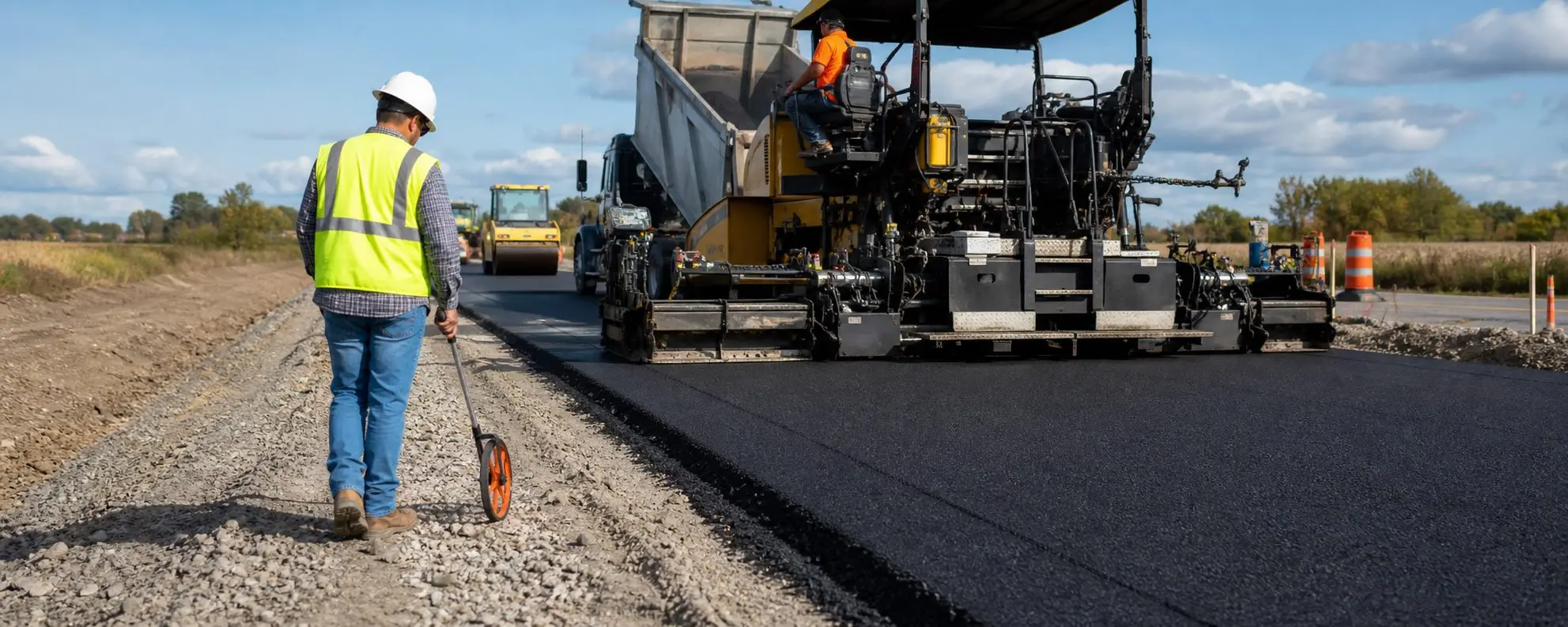
Bitumen quantity calculation is a fundamental skill for every road engineer, estimator, and contractor. Whether you are pricing a major highway tender, ordering materials for a paving crew, or verifying a subcontractor's scope, getting the quantity right saves money and prevents costly shortfalls on site. This guide walks you through the core three-step formula, density and binder content reference values, and a complete worked example for a standard road overlay.
The Core Three-Step Formula
Road bitumen quantity calculation always follows the same physical sequence: calculate compacted volume first, convert volume to total asphalt mix weight using laboratory-calibrated density, then extract the bitumen fraction using the binder content percentage.
For most dense-graded hot mix asphalt (HMA), compacted density ranges from 2,300 to 2,400 kg/m³ and bitumen content commonly falls between 5.0% and 6.5% by mass. Use your project's approved job-mix formula (JMF) values for precise tender or plant orders.
Worked Example — 1 km Single-Lane Overlay
Let's calculate the bitumen and asphalt required for a 50 mm wearing course overlay on a 1 km section of single-lane road with a standard 7.2 m carriageway width.
This 846 t of asphalt mix contains 46.53 t of bitumen binder plus approximately 799.47 t of mineral aggregate (stone, sand, and mineral filler). Use the material calculator to split total mix into individual aggregate grading fractions automatically.
Multi-Layer Road Calculation
Most structural road pavement designs use multiple bituminous layers — typically a wearing course, binder course, and asphalt base course. Calculate each layer separately using its specific lift thickness and mix density, then sum the quantities. Here is an engineering takeoff for a new sub-arterial road (1 km × 7.0 m carriageway):
| Pavement Layer | Thickness | Compacted Density | Mix Weight | Binder % | Net Bitumen Takeoff |
|---|---|---|---|---|---|
| Wearing Course (AC 10) | 40 mm | 2,350 kg/m³ | 658.0 t | 5.8% | 38.16 t |
| Binder Course (AC 14) | 60 mm | 2,380 kg/m³ | 999.6 t | 4.9% | 48.98 t |
| Base Course (AC 20) | 100 mm | 2,400 kg/m³ | 1,680.0 t | 4.2% | 70.56 t |
| Total Bitumen Binder Required: | 157.70 t | ||||
For multi-layer road projects, run the road asphalt calculator for each distinct pavement layer. Record each result and add the layer totals to arrive at your final refinery and hot-mix plant orders.
Density Reference Values by Mix Type
Density is the most sensitive variable in quantity estimating. Entering an uncompacted loose density or guessing without laboratory test data can introduce errors of 3% to 8% in your final tender sum. Use these industry-standard compacted density ranges:
| Asphalt Mix Type | Compacted Density (kg/m³) | Density (lb/ft³) | Application Notes |
|---|---|---|---|
| Dense Graded HMA (Wearing Course) | 2,300 – 2,400 | 143.6 – 149.8 | Standard highway, arterial, and urban surface course |
| Stone Mastic Asphalt (SMA) | 2,350 – 2,450 | 146.7 – 153.0 | Heavy rut-resistant aggregate skeleton with polymer binder |
| Open-Graded Friction Course (OGFC) | 2,000 – 2,200 | 124.9 – 137.3 | High interconnecting air voids (18–22%) reduce bulk density |
| Asphalt Base / Heavy Roadbase (AC 28) | 2,350 – 2,420 | 146.7 – 151.1 | Large 28mm aggregate gradation for heavy axle load distribution |
| Cold Mix / Emulsion Treated Base | 1,900 – 2,150 | 118.6 – 134.2 | Higher void structure than plant-compacted hot mix |
Typical Binder Content Reference Values
Bitumen (binder) content varies based on nominal maximum aggregate size (NMAS), structural function, and regional climate conditions:
- Wearing Course (AC 10 / NMAS 9.5 mm): 5.2% – 6.5% by mass of total mix. High binder content provides impermeability and fatigue resistance against traffic wear.
- Binder Course (AC 14 / NMAS 12.5 mm): 4.5% – 5.5% by mass. Balances load transmission with shear resistance.
- Base Course (AC 20 / AC 28): 3.8% – 4.8% by mass. Heavy structural support where thick asphalt layers reduce thermal cracking susceptibility.
- Stone Mastic Asphalt (SMA): 5.5% – 7.0% by mass. Rich mastic binder mortar combined with cellulose fibers to prevent drain-down.
- Open-Graded Friction Course: 4.5% – 6.0% by mass. Uses modified or neat binder with fibers to coat open stone structures.
To verify delivered binder percentages on site, solvent extraction or ignition furnace testing per ASTM D6307 / AASHTO T 308 is conducted. See our bitumen content guide for complete extraction calculations and optimum binder content (OBC) determination.
Common Estimating Mistakes to Avoid
-
Confusing Loose vs Compacted Density: Always use compacted density (2,300–2,400 kg/m³) for finished thickness takeoff. Loose mix in haul trucks weighs only 1,400–1,600 kg/m³.
-
Using Millimeters Instead of Meters: When calculating volume manually, 50 mm must be converted to 0.050 m. Forgetting this decimal shifts the calculated tonnage by 1,000×.
-
Bitumen Tons vs Total Mix Tons: Asphalt delivery dockets reflect total mixed material. If you order 846 tonnes of mix, the bitumen content is 46.5 tonnes, not 846 tonnes of binder.
-
Omitting Haulage & Joint Waste: Always add 3% to 5% site allowance for joint trimming, transverse transitions, paver hopper remnants, and pavement crown variations.
-
Mixing Imperial and Metric Units: Convert square yards and feet to square meters before multiplying by metric density. Use our measurement calculator to ensure unit parity.
Which Calculator Should You Use?
BitumenCalc provides dedicated calculation engines tailored to each phase of your road paving project: