Knowledge Hub

Asphalt Thickness Guide: Driveways, Parking Lots, Roads & Overlays

Learn the recommended asphalt thickness for driveways, parking lots, roads, overlays, and heavy-duty areas. Includes thickness tables, formulas, examples, and calculator guidance.

Guide
Asphalt pavement core and measuring tools used to check compacted layer thickness
Choosing the right asphalt thickness depends on traffic loading, base strength, and the pavement use case.

Asphalt thickness can make or break a paving project.

Too thin, and the surface may crack, rut, sink, or fail early.

Too thick, and the project may become more expensive than necessary.

That is why choosing the right asphalt thickness is one of the most important decisions in driveway, parking lot, road, and overlay construction.

A small difference in thickness can change the total asphalt quantity by several tons. It also changes the cost, strength, service life, and repair frequency of the pavement.

This guide explains asphalt thickness in a simple way.

You will learn recommended thickness ranges for residential driveways, commercial parking lots, access roads, overlays, repairs, and heavy-duty paving areas. You will also see formulas, examples, tables, and calculator tips to help estimate asphalt quantity more accurately.

For fast calculation, use the Asphalt Thickness Calculator or the Asphalt Tonnage Calculator on BitumenCalc.

Quick Answer: What Asphalt Thickness Should You Use?

For most residential driveways, asphalt thickness is commonly around 2 to 4 inches or 50 to 100 mm, depending on the base and vehicle load.

For parking lots, the asphalt thickness is often around 3 to 6 inches or 75 to 150 mm, depending on traffic type.

For road construction, asphalt thickness can be much higher because roads carry repeated traffic loads.

Project Type Common Asphalt Thickness
Light residential driveway 2 in / 50 mm
Standard residential driveway 3 in / 75 mm
Heavy residential driveway 4 in / 100 mm
Light parking lot 3 in / 75 mm
Commercial parking lot 4–6 in / 100–150 mm
Asphalt overlay 1.5–3 in / 40–75 mm
Local access road 4–8 in / 100–200 mm
Heavy-duty pavement 6+ in / 150+ mm

These are general planning ranges. Final thickness depends on soil strength, aggregate base, drainage, climate, traffic load, and local engineering requirements.

Why Asphalt Thickness Matters

Asphalt is not only a black surface layer.

It is part of a pavement structure. The asphalt layer works with the base, sub-base, soil, drainage, and compaction to carry traffic loads.

If the asphalt layer is too thin, the pavement may fail early.

Common problems include:

  • Cracking
  • Rutting
  • Potholes
  • Edge breaking
  • Surface deformation
  • Water damage
  • Settlement
  • Base failure

If the asphalt layer is too thick without proper design, the project may cost more than needed.

So, the goal is balance.

You need enough asphalt to handle traffic and weather, but not so much that you waste material and money.

Asphalt Thickness Is Usually Compacted Thickness

This point is important.

When engineers or contractors talk about asphalt thickness, they usually mean compacted thickness.

That means the final thickness after rolling and compaction.

Fresh asphalt is placed loose. Then it is compacted with rollers. During compaction, the layer becomes denser and slightly thinner.

Term Meaning
Loose thickness Thickness before rolling
Compacted thickness Final thickness after compaction
Lift thickness Thickness of one asphalt layer
Total asphalt thickness Combined compacted thickness of all lifts

For example, if the required final thickness is 3 inches, the contractor may place the asphalt slightly thicker before compaction.

For estimating tonnage, always use the required compacted thickness unless your project specification says otherwise.

Recommended Asphalt Thickness for Driveways

Residential driveways are usually lighter than roads and commercial parking areas. But they still need proper thickness and a strong base.

A driveway used only by small cars may need less asphalt than a driveway used by vans, trailers, delivery vehicles, or heavy pickup trucks.

Driveway Type Recommended Asphalt Thickness
Light-use residential driveway 2 in / 50 mm
Standard residential driveway 3 in / 75 mm
Heavy-use residential driveway 4 in / 100 mm
Driveway with occasional vans 3–4 in / 75–100 mm
Driveway with frequent heavy vehicles 4+ in / 100+ mm

For many home driveways, 3 inches or 75 mm is a practical middle option.

However, thickness alone does not guarantee strength. A weak base can destroy a thick asphalt layer. A strong, well-compacted base can make a moderate asphalt layer perform much better.

2-Inch vs 3-Inch vs 4-Inch Asphalt Driveway

The difference between 2 inches, 3 inches, and 4 inches may sound small.

But in asphalt tonnage, the difference is big.

Example driveway:

  • Area: 1,000 ft²
  • Asphalt density: 145 lb/ft³
Thickness Approx. Tons Needed
2 inches 12.08 tons
3 inches 18.13 tons
4 inches 24.17 tons

A 4-inch driveway needs about double the asphalt of a 2-inch driveway.

That means double the material weight, and often a much higher cost.

This is why you should not guess thickness. Choose it based on use, base quality, and expected load.

Recommended Asphalt Thickness for Parking Lots

Parking lots carry more traffic than residential driveways. They may also carry turning vehicles, delivery vans, garbage trucks, buses, or commercial traffic.

Thickness should match the traffic level.

Parking Lot Type Common Asphalt Thickness
Light car parking 3 in / 75 mm
Standard commercial parking 4 in / 100 mm
Medium-duty parking lot 4–5 in / 100–125 mm
Heavy-duty parking area 5–6 in / 125–150 mm
Truck loading area 6+ in / 150+ mm

Car-only parking areas do not need the same thickness as loading bays.

The most common mistake is using the same thickness everywhere. A better design often uses lighter thickness in parking stalls and heavier thickness in drive lanes or loading areas.

Parking Lot Zones and Thickness

A parking lot usually has different traffic zones.

Each zone may need a different pavement thickness.

Parking Lot Zone Traffic Load Thickness Approach
Parking stalls Low Standard car thickness
Drive aisles Medium Slightly thicker
Entrance/exit Medium to high Stronger pavement
Delivery area High Heavy-duty thickness
Garbage truck route Very high Thick asphalt and strong base
Loading dock Very high Heavy-duty design

If heavy trucks turn sharply on thin asphalt, rutting and surface damage can appear quickly.

For commercial lots, the base layer and compaction are just as important as asphalt depth.

Recommended Asphalt Thickness for Roads

Road thickness depends heavily on traffic volume and vehicle load.

A small access road does not need the same pavement structure as a highway.

Road Type Common Asphalt Thickness
Private access road 4–6 in / 100–150 mm
Light local road 4–8 in / 100–200 mm
Medium traffic road 6–10 in / 150–250 mm
Heavy traffic road 8+ in / 200+ mm
Industrial road 8+ in / 200+ mm, depending on load

Road design should normally follow engineering standards. It should consider subgrade strength, traffic loading, drainage, climate, base material, and pavement life.

For road material quantity estimation, use a Road Construction Calculator to calculate area, volume, tonnage, and material needs.

Asphalt Overlay Thickness

An asphalt overlay is a new asphalt layer placed over an existing surface.

Overlay thickness is usually thinner than full-depth construction.

Common overlay thickness:

Overlay Type Common Thickness
Thin surface overlay 1–1.5 in / 25–40 mm
Standard asphalt overlay 1.5–2 in / 40–50 mm
Stronger overlay 2–3 in / 50–75 mm
Structural overlay 3+ in / 75+ mm

An overlay works only if the existing pavement is stable.

If the old asphalt has deep cracks, potholes, drainage problems, or base failure, a simple overlay may not last. The damage can reflect through the new layer.

When an Asphalt Overlay Is Not Enough

An overlay may look like a cheaper solution. Sometimes it is.

But it is not always the right choice.

Avoid overlay-only repair when you see:

  • Deep potholes
  • Severe alligator cracking
  • Major settlement
  • Standing water
  • Weak base
  • Pumping mud or water
  • Large edge failures
  • Severe rutting
  • Poor drainage

In these cases, removal and base repair may be needed before new asphalt is placed.

A new asphalt layer cannot fix a bad foundation.

Asphalt Thickness for Repairs and Patches

Patch thickness depends on the depth and purpose of the repair.

Repair Type Typical Thickness
Surface patch 1–2 in / 25–50 mm
Pothole patch Match existing depth
Utility trench repair Match or exceed existing pavement
Full-depth repair Entire asphalt depth
Heavy-duty repair Based on traffic load

For small repairs, matching the existing asphalt thickness is usually better than placing a very thin patch.

If a patch is too thin, it may break loose, crack, or fail under traffic.

Asphalt Thickness for Heavy Vehicles

Heavy vehicles require stronger pavement.

A driveway used by cars is very different from a driveway used by trucks, buses, garbage vehicles, or loaded trailers.

Heavy vehicle areas may need:

  • Thicker asphalt
  • Stronger aggregate base
  • Better compaction
  • Stronger subgrade
  • Edge support
  • Proper drainage
Vehicle Load Suggested Asphalt Thickness
Cars only 2–3 in / 50–75 mm
Cars and SUVs 3 in / 75 mm
Vans and light trucks 3–4 in / 75–100 mm
Delivery trucks 4–6 in / 100–150 mm
Heavy trucks 6+ in / 150+ mm

For commercial or industrial loads, ask an engineer or follow local pavement design standards.

Asphalt Thickness and Base Thickness

Asphalt does not work alone.

The base layer underneath the asphalt carries and spreads loads.

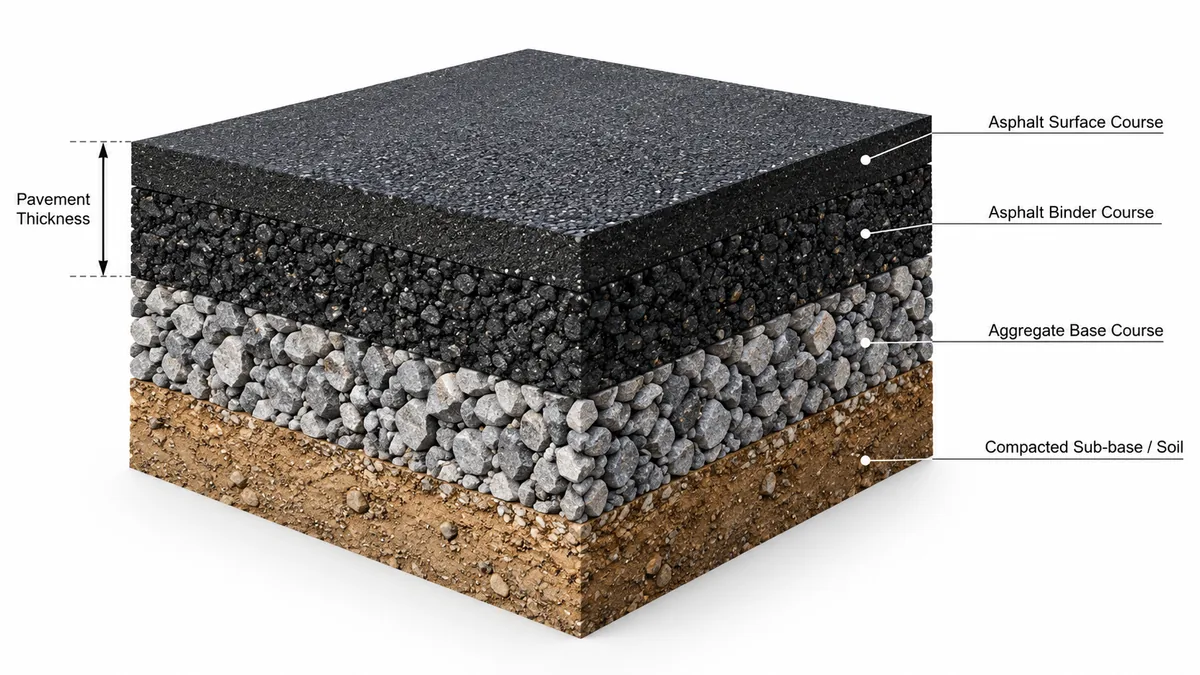
A typical pavement structure may include:

  • Asphalt surface layer
  • Asphalt binder layer
  • Aggregate base
  • Sub-base
  • Compacted subgrade soil
Layer Purpose
Asphalt surface Smooth riding surface and waterproofing
Asphalt binder Structural support
Aggregate base Load distribution
Sub-base Extra support and drainage
Subgrade Natural soil foundation

If the base is weak, even thick asphalt may crack.

If the base is strong, the pavement can perform better with a reasonable asphalt thickness.

Common Base Thickness Ranges

Base thickness depends on soil and traffic.

Project Type Common Aggregate Base Thickness
Light residential driveway 4–6 in / 100–150 mm
Standard driveway 6–8 in / 150–200 mm
Commercial parking lot 8–12 in / 200–300 mm
Heavy-duty area 12+ in / 300+ mm
Road construction Designed by traffic and soil data

These are general ranges only. Poor soil, wet areas, or heavy traffic may require thicker base or improved subgrade.

Asphalt Thickness and Drainage

Water is one of the biggest enemies of asphalt pavement.

Even good asphalt can fail if water enters the pavement structure and weakens the base.

Proper drainage includes:

  • Correct slope
  • No standing water
  • Good edge drainage
  • Stable shoulders
  • Proper grading
  • Sealed cracks
  • Controlled runoff

A thicker asphalt layer will not solve poor drainage by itself.

If water remains under or beside the pavement, the base can soften. Once the base fails, cracks and potholes appear.

Asphalt Thickness Calculator Formula

To calculate asphalt quantity from thickness, use this formula.

Metric Formula

Tons = Length (m) × Width (m) × Thickness (m) × Density (kg/m³) ÷ 1000

Imperial Formula

Tons = Length (ft) × Width (ft) × Thickness (ft) × Density (lb/ft³) ÷ 2000

Thickness must be converted correctly.

Thickness Feet Meters
2 in / 50 mm 0.167 ft 0.05 m
3 in / 75 mm 0.25 ft 0.075 m
4 in / 100 mm 0.333 ft 0.10 m
6 in / 150 mm 0.5 ft 0.15 m

You can avoid manual mistakes by using the Asphalt Thickness Calculator.

Example 1: Driveway Thickness Calculation

Suppose you have a residential driveway:

  • Length: 20 m
  • Width: 4 m
  • Thickness: 75 mm
  • Density: 2,400 kg/m³

Step 1: Area

20 × 4 = 80 m²

Step 2: Convert Thickness

75 mm = 0.075 m

Step 3: Calculate Volume

80 × 0.075 = 6 m³

Step 4: Convert to Tons

6 × 2400 ÷ 1000 = 14.4 tons

So, a 20 m × 4 m driveway at 75 mm thickness needs about 14.4 metric tons of asphalt.

Example 2: Parking Lot Thickness Calculation

Suppose you have a small parking lot:

  • Length: 100 ft
  • Width: 60 ft
  • Thickness: 4 inches
  • Density: 145 lb/ft³

Step 1: Area

100 × 60 = 6,000 ft²

Step 2: Convert Thickness

4 inches ÷ 12 = 0.333 ft

Step 3: Volume

6,000 × 0.333 = 1,998 ft³

Step 4: Tons

1,998 × 145 ÷ 2000 = 144.86 tons

So, the parking lot needs about 145 tons of asphalt at 4 inches thick.

Example 3: Asphalt Overlay Calculation

Suppose an existing driveway needs an overlay:

  • Area: 1,200 ft²
  • Overlay thickness: 2 inches
  • Density: 145 lb/ft³

Convert Thickness

2 inches ÷ 12 = 0.167 ft

Volume

1,200 × 0.167 = 200.4 ft³

Tons

200.4 × 145 ÷ 2000 = 14.53 tons

So, a 2-inch overlay over 1,200 ft² needs about 14.5 tons of asphalt.

Asphalt Thickness Cost Comparison

Thickness directly affects cost because it changes asphalt tonnage.

Example:

  • Area: 100 m²
  • Density: 2,400 kg/m³
  • Asphalt price: 100 per ton
Thickness Asphalt Tons Material Cost
50 mm 12 tons 1,200
75 mm 18 tons 1,800
100 mm 24 tons 2,400
125 mm 30 tons 3,000
150 mm 36 tons 3,600

The pattern is simple.

More thickness means more volume.

More volume means more tons.

More tons means higher cost.

You can compare different thickness options with the Asphalt Cost Calculator.

Asphalt Thickness by Traffic Type

Traffic load is one of the biggest factors in pavement thickness.

Traffic Type Typical Project Asphalt Thickness
Very light Walkways, small paths 1.5–2 in / 40–50 mm
Light Home driveway 2–3 in / 50–75 mm
Medium Parking lot drive aisle 3–4 in / 75–100 mm
Medium-heavy Commercial lot 4–6 in / 100–150 mm
Heavy Truck route 6+ in / 150+ mm
Very heavy Industrial yard Engineered design needed

A surface used by turning trucks needs more strength than one used only by parked cars.

Turning movements create stress. This is why loading areas, entrances, and truck routes often fail first.

Asphalt Thickness by Climate

Climate can also influence thickness and pavement design.

Cold areas may experience freeze-thaw cycles. Hot areas may experience softening, rutting, and surface deformation if the mix is not suitable.

Climate Condition Thickness/Design Consideration
Cold climate Strong base and drainage are important
Hot climate Mix type and rut resistance matter
Wet climate Drainage and sealing are critical
Freeze-thaw areas Avoid water trapped under pavement
Desert/high heat areas Proper binder grade matters
Coastal areas Moisture control and base stability matter

Thickness helps, but climate design is not only about thickness. Mix type, binder grade, drainage, and compaction also matter.

Asphalt Lift Thickness

Asphalt is often placed in layers called lifts.

A project may use one lift or multiple lifts.

Total Thickness Possible Placement Method
2 in One lift
3 in One or two lifts
4 in Usually two lifts
6 in Multiple lifts
8+ in Multiple structural lifts

Very thick asphalt should not usually be placed in one single lift. Proper lift thickness helps compaction.

If asphalt is placed too thick in one lift, it may not compact properly through the full depth. If it is placed too thin, it may cool too quickly and also fail to compact well.

Surface Course vs Binder Course

Many asphalt pavements have more than one asphalt layer.

Layer Purpose
Surface course Smooth top layer, waterproofing, skid resistance
Binder course Structural support below surface
Base course Deeper structural asphalt layer, if used

A driveway may use a simpler structure. A road or commercial pavement may use multiple courses.

Example:

Pavement Type Possible Asphalt Structure
Residential driveway 3 in total asphalt
Commercial lot 2 in surface + 2 in binder
Heavy-duty lot 2 in surface + 4 in binder/base
Road Multi-layer engineered structure

The total thickness is the combined compacted thickness of all asphalt layers.

How to Choose the Right Asphalt Thickness

Use this simple decision process.

Choose 2 inches / 50 mm when:

  • Traffic is very light
  • Base is strong
  • Project is a light overlay
  • No heavy vehicles are expected
  • Existing pavement is stable

Choose 3 inches / 75 mm when:

  • It is a normal residential driveway
  • Cars and SUVs will use it
  • Base is properly prepared
  • You want a practical balance of strength and cost

Choose 4 inches / 100 mm when:

  • Heavy residential vehicles may use it
  • The driveway gets frequent traffic
  • There are vans or trailers
  • You want extra durability
  • Soil or base conditions need more strength

Choose 6 inches / 150 mm or more when:

  • Trucks use the area
  • It is a commercial loading zone
  • It is an industrial pavement
  • The traffic load is high
  • Engineering design requires it

Asphalt Thickness and Compaction Quality

Thickness matters. But compaction quality is just as important.

Poor compaction can cause:

  • Air voids
  • Water penetration
  • Cracking
  • Rutting
  • Loose surface
  • Short pavement life

Good compaction helps asphalt become dense, strong, and durable.

Important compaction factors include:

  • Asphalt temperature
  • Roller type
  • Rolling pattern
  • Lift thickness
  • Mix design
  • Weather conditions
  • Time before cooling

A correctly designed asphalt thickness can still fail if compaction is poor.

Asphalt Thickness and Edge Support

Driveway and road edges are vulnerable.

If the edge is unsupported, it may break under vehicle load.

Edge support can include:

  • Concrete curb
  • Shoulder support
  • Compacted gravel edge
  • Proper grading
  • Edge restraint
  • Avoiding heavy loads near the edge

Thin asphalt edges break faster. A thicker asphalt layer with proper edge support performs better.

Asphalt Thickness for Sloped Driveways

Sloped driveways need extra attention.

Slope can affect:

  • Water runoff
  • Braking stress
  • Surface wear
  • Edge erosion
  • Drainage direction
  • Compaction difficulty

A steep driveway may need better surface texture, drainage, and base stability.

Thickness should be selected with site conditions in mind. Do not use the same assumption for every driveway if the site has drainage or slope issues.

Asphalt Thickness for Private Roads and Farm Roads

Private roads often carry mixed traffic.

They may be used by cars, pickup trucks, trailers, farm equipment, or delivery vehicles.

Common private road thickness:

Road Use Asphalt Thickness
Light private access 3–4 in / 75–100 mm
Regular car traffic 4–5 in / 100–125 mm
Pickup trucks and trailers 5–6 in / 125–150 mm
Heavy equipment access Engineered design recommended

Long private roads can become expensive quickly. Always calculate tonnage before ordering.

How Thickness Changes Asphalt Quantity

The relationship is direct.

If you double the thickness, you roughly double the asphalt quantity.

Example for 1,000 ft²:

Thickness Tons Needed
1 inch 6.04 tons
2 inches 12.08 tons
3 inches 18.13 tons
4 inches 24.17 tons
5 inches 30.21 tons
6 inches 36.25 tons

This is why an asphalt thickness calculator is useful. It shows the cost and tonnage impact before work starts.

Asphalt Thickness Calculator Inputs

To calculate asphalt quantity based on thickness, you need:

Input Example
Length 50 ft
Width 20 ft
Thickness 3 inches
Density 145 lb/ft³
Waste factor 5%
Price per ton Optional

With these inputs, you can calculate:

  • Area
  • Volume
  • Tons required
  • Cost estimate
  • Waste-adjusted quantity

If you already know the area, you can skip length and width and calculate from area and thickness.

Waste Allowance for Asphalt Thickness Estimates

Real-world paving is not always perfect.

A small waste allowance helps cover:

  • Uneven base
  • Edge loss
  • Minor measurement errors
  • Shape irregularities
  • Compaction variation
  • Small site adjustments

Common waste allowances:

Project Type Suggested Waste
Simple driveway 3–5%
Irregular driveway 5–8%
Parking lot 3–7%
Patch repair 5–10%
Road project Based on specification

Example:

If calculated tonnage is 18 tons and waste is 5%:

18 × 1.05 = 18.9 tons

Final estimated asphalt quantity: 18.9 tons

Common Asphalt Thickness Mistakes

Avoid these common errors.

Mistake Problem
Choosing thickness only by price May reduce pavement life
Ignoring base condition Asphalt may fail early
Using area without thickness Tonnage estimate is wrong
Mixing inches and feet Calculation error
Ignoring heavy vehicles Rutting and cracking risk
Overlaying failed pavement Cracks return quickly
No drainage plan Water damages base
Poor compaction Weak pavement
No edge support Edge cracking and breaking

The biggest mistake is thinking asphalt thickness alone solves everything.

A good pavement needs proper thickness, base, drainage, compaction, and material quality.

Simple Thickness Selection Table

Use this table for fast planning.

Project Light Use Standard Use Heavy Use
Residential driveway 2 in 3 in 4 in
Parking lot 3 in 4 in 5–6 in
Overlay 1.5 in 2 in 3 in
Access road 4 in 5–6 in 6+ in
Industrial yard Not recommended 6 in Engineered design

This is a planning guide, not a final engineering design.

Recommended Featured Snippet Answer

Add this near the top of the blog:

Residential asphalt driveways are commonly 2 to 4 inches thick. A standard driveway often uses around 3 inches of compacted asphalt, while heavy-use driveways may need 4 inches or more. Parking lots commonly use 3 to 6 inches, and overlays usually use 1.5 to 3 inches depending on the existing pavement condition.

This gives search engines a direct answer and helps target featured snippets.

FAQ: Asphalt Thickness Guide

1. What is the best asphalt thickness for a driveway?

A common residential asphalt driveway thickness is around 3 inches or 75 mm. Light-use driveways may use 2 inches, while heavy-use driveways may need 4 inches or more.

2. Is 2 inches of asphalt enough for a driveway?

2 inches may be enough for a light-use residential driveway with a strong base and good drainage. For standard use, 3 inches is often a better option.

3. Is 3 inches of asphalt enough?

Yes, 3 inches is commonly used for standard residential driveways. It gives a practical balance between cost and durability when the base is properly prepared.

4. How thick should asphalt be for a parking lot?

Light parking lots may use around 3 inches. Commercial parking lots often use 4 to 6 inches, especially in drive aisles and heavy-traffic areas.

5. How thick should asphalt overlay be?

A common asphalt overlay thickness is 1.5 to 2 inches. Stronger overlays may be 2 to 3 inches. The existing pavement must be stable.

6. How thick should asphalt be for heavy trucks?

Heavy truck areas often need 6 inches or more of asphalt, along with a strong base. Industrial or truck pavements should follow engineering design.

7. Does thicker asphalt last longer?

Thicker asphalt can improve strength, but only if the base, drainage, mix, and compaction are also correct. Thickness alone cannot fix poor construction.

8. What is compacted asphalt thickness?

Compacted thickness is the final asphalt thickness after rolling. Asphalt is placed loose and then compacted to the required final depth.

9. How do I calculate asphalt tons from thickness?

Use:

Tons = Area × Thickness × Density

For metric:

Tons = Length × Width × Thickness × Density ÷ 1000

10. Does asphalt thickness affect cost?

Yes. More thickness means more volume, more tons, and higher material cost. Doubling thickness roughly doubles asphalt quantity.

11. Can I put new asphalt over old asphalt?

Yes, if the old asphalt is stable. If the existing surface has major cracks, potholes, drainage issues, or base failure, repairs may be needed first.

12. What happens if asphalt is too thin?

Thin asphalt may crack, rut, break at edges, form potholes, or fail early, especially under heavy vehicles or poor base conditions.

Final Thoughts

Choosing the right asphalt thickness is not about guessing.

It depends on traffic, base strength, drainage, soil, climate, and project type.

For many residential driveways, 3 inches or 75 mm is a common choice. For parking lots, 3 to 6 inches is more typical. For overlays, 1.5 to 3 inches may be enough if the existing pavement is sound. For roads and heavy-duty areas, proper design is needed.

The simplest way to understand the quantity impact is to calculate the asphalt tons at different thicknesses.

Use the Asphalt Thickness Calculator and Asphalt Tonnage Calculator on BitumenCalc to compare thickness options before ordering material or accepting a quote.

A well-planned asphalt thickness can save money, reduce repairs, and make the pavement last longer.

Calculate Your Asphalt Quantity Now

Get fast, accurate estimates for any paving project.

Open Calculator