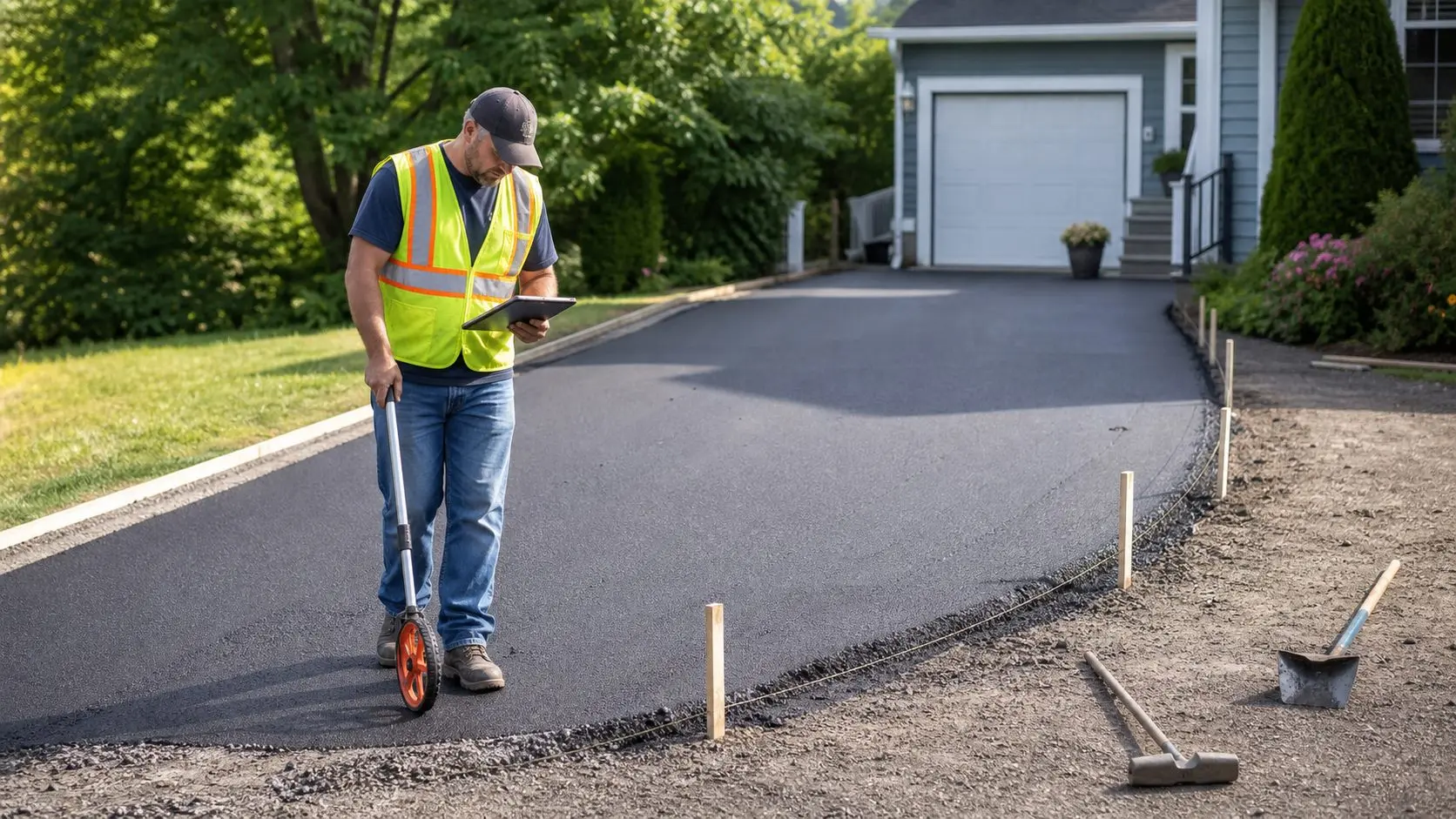
Planning an asphalt driveway sounds simple at first.
Measure the space. Call a contractor. Get a price.
But then the questions start.
How thick should the asphalt be?
How many tons are needed?
How much will the material cost?
Is the estimate too high?
Is the driveway strong enough for cars, vans, or small trucks?
That is where an asphalt driveway cost calculator becomes useful.
A proper estimate is not only about square meters or square feet. Asphalt is normally priced by weight, usually tons. So, to calculate the cost of an asphalt driveway, you need to know the area, thickness, density, tonnage, and price per ton.
This guide explains the full calculation in a simple way.
You will learn how to estimate driveway asphalt cost manually, how to use the right formula, what thickness to choose, and which mistakes can make your estimate wrong.
For fast calculation, you can use the Asphalt Cost Calculator or the Asphalt Tonnage Calculator on BitumenCalc.
Quick Answer: How Do You Estimate Asphalt Driveway Cost?
To estimate asphalt driveway cost, calculate the paved area, multiply it by asphalt thickness, convert the volume into tons using asphalt density, then multiply the tons by the asphalt price per ton.
The basic formula is:
To find asphalt tons:
For metric calculation:
For imperial calculation:
A common asphalt density estimate is around 2,300 to 2,450 kg/m³ or 140 to 155 lb/ft³, depending on the mix type and compaction.
Why Asphalt Driveway Cost Is Not Based on Area Alone
Many people ask:
“How much does asphalt cost per square meter?”
That question is useful, but incomplete.
A 100 m² driveway with 50 mm asphalt is not the same as a 100 m² driveway with 100 mm asphalt. The second one needs almost double the asphalt.
So, the real cost depends on more than area.
| Cost Factor | Why It Matters |
|---|---|
| Driveway area | Larger area needs more asphalt |
| Asphalt thickness | More thickness means more volume |
| Asphalt density | Higher density increases weight |
| Price per ton | Material price changes by supplier and region |
| Base preparation | Weak base can increase total cost |
| Labor and equipment | Small jobs often cost more per unit |
| Transport distance | Delivery affects final price |
| Drainage and slope | Extra preparation may be required |
This is why a driveway cost calculator should include both area and thickness.
A flat square-meter price can give a rough estimate, but it can also mislead you if the thickness is not included.
Asphalt Driveway Cost Formula
The full asphalt driveway cost formula has four main steps.
Step 1: Calculate Area
For a rectangular driveway:
For metric:
For imperial:
Step 2: Convert Thickness
Thickness must be converted into meters or feet.
| Thickness | Metric Conversion | Imperial Conversion |
|---|---|---|
| 50 mm | 0.05 m | 1.97 in |
| 75 mm | 0.075 m | 2.95 in |
| 100 mm | 0.10 m | 3.94 in |
| 125 mm | 0.125 m | 4.92 in |
| 150 mm | 0.15 m | 5.91 in |
For imperial formulas, inches must be converted to feet:
Example:
Step 3: Calculate Asphalt Volume
Metric:
Imperial:
Step 4: Convert Volume to Tons
Metric:
Imperial:
Step 5: Calculate Cost
If you also want to include labor, base work, transport, and equipment, use:
Example 1: Asphalt Driveway Cost Calculation in Metric
Let’s calculate a simple driveway.
Driveway size:
- Length: 20 meters
- Width: 4 meters
- Asphalt thickness: 75 mm
- Asphalt density: 2,400 kg/m³
- Asphalt price: 100 per ton
1. Calculate Area
2. Convert Thickness
3. Calculate Volume
4. Calculate Tons
5. Calculate Cost
So, the estimated asphalt material cost is 1,440, before labor, transport, base work, and other site charges.
Example 2: Asphalt Driveway Cost Calculation in Feet and Inches
Now let’s calculate in imperial units.
Driveway size:
- Length: 60 ft
- Width: 12 ft
- Asphalt thickness: 3 inches
- Asphalt density: 145 lb/ft³
- Asphalt price: 120 per ton
1. Calculate Area
2. Convert Thickness
3. Calculate Volume
4. Calculate Tons
5. Calculate Cost
So, the estimated asphalt material cost is 1,566, before other project costs.
Asphalt Driveway Thickness Guide
Thickness is one of the biggest cost factors.
A thin driveway uses less asphalt, but it may not last long if the base is weak or the driveway carries heavy vehicles. A thicker driveway costs more, but it can handle more load when installed properly.
| Driveway Use | Common Asphalt Thickness | Notes |
|---|---|---|
| Light residential driveway | 50 mm / 2 in | Suitable for small cars with strong base |
| Standard home driveway | 75 mm / 3 in | Common choice for normal vehicles |
| Heavy residential use | 100 mm / 4 in | Better for SUVs, vans, and frequent use |
| Commercial driveway | 100–150 mm / 4–6 in | Depends on traffic and base design |
| Overlay on existing asphalt | 40–60 mm / 1.5–2.5 in | Existing surface must be stable |
For most residential driveways, 75 mm or 3 inches is a common starting point. But the final thickness should depend on soil condition, base layer, drainage, vehicle load, and local construction standards.
If you are unsure, calculate multiple options using an Asphalt Thickness Calculator. Compare 50 mm, 75 mm, and 100 mm to see how the cost changes.
Asphalt Tons Needed by Driveway Size
The table below uses an approximate asphalt density of 2,400 kg/m³.
| Driveway Area | 50 mm Thick | 75 mm Thick | 100 mm Thick |
|---|---|---|---|
| 25 m² | 3.0 tons | 4.5 tons | 6.0 tons |
| 50 m² | 6.0 tons | 9.0 tons | 12.0 tons |
| 75 m² | 9.0 tons | 13.5 tons | 18.0 tons |
| 100 m² | 12.0 tons | 18.0 tons | 24.0 tons |
| 150 m² | 18.0 tons | 27.0 tons | 36.0 tons |
| 200 m² | 24.0 tons | 36.0 tons | 48.0 tons |
This table is useful for quick planning. For accurate results, enter your actual driveway size into a calculator.
Asphalt Tons Needed by Square Feet
The table below uses an approximate density of 145 lb/ft³.
| Driveway Area | 2 in Thick | 3 in Thick | 4 in Thick |
|---|---|---|---|
| 500 ft² | 6.04 tons | 9.06 tons | 12.08 tons |
| 750 ft² | 9.06 tons | 13.59 tons | 18.13 tons |
| 1,000 ft² | 12.08 tons | 18.13 tons | 24.17 tons |
| 1,250 ft² | 15.10 tons | 22.66 tons | 30.21 tons |
| 1,500 ft² | 18.13 tons | 27.19 tons | 36.25 tons |
| 2,000 ft² | 24.17 tons | 36.25 tons | 48.33 tons |
This gives a quick idea of how thickness affects tonnage. A 3-inch driveway needs about 50% more asphalt than a 2-inch driveway.
Asphalt Cost Estimate by Driveway Size
The table below shows a simple material-only estimate.
It uses:
- Asphalt density: 2,400 kg/m³
- Thickness: 75 mm
- Example asphalt price: 100 per ton
| Driveway Area | Estimated Tons | Material Cost at 100/Ton |
|---|---|---|
| 25 m² | 4.5 tons | 450 |
| 50 m² | 9.0 tons | 900 |
| 75 m² | 13.5 tons | 1,350 |
| 100 m² | 18.0 tons | 1,800 |
| 150 m² | 27.0 tons | 2,700 |
| 200 m² | 36.0 tons | 3,600 |
You can replace the example price with your local price per ton.
For example, if your supplier price is 130 per ton, then:
What Is Included in Asphalt Driveway Cost?
An asphalt driveway estimate may include only material, or it may include the complete job.
Before comparing quotes, check what is included.
| Item | Usually Included? | Notes |
|---|---|---|
| Asphalt material | Yes | Main paving material |
| Delivery | Sometimes | Depends on supplier and distance |
| Base preparation | Sometimes | Important for long-term strength |
| Excavation | Not always | Needed for new driveways |
| Compaction | Usually | Required for proper finish |
| Labor | Yes in contractor quote | Not included in material-only calculators |
| Drainage work | Sometimes | Extra cost if slope/water issue exists |
| Edging | Sometimes | Can improve finish and durability |
| Old asphalt removal | Not always | Extra cost for replacement jobs |
A calculator gives a strong starting estimate. But a contractor quote should also include site preparation and installation details.
Material Cost vs Total Project Cost
This is important.
An asphalt cost calculator usually gives the material cost or a basic project estimate. But the full project cost may be higher.
Material-only estimate
This includes asphalt tons multiplied by price per ton.
Full installed estimate
This includes material plus labor and site work.
A small driveway can have a higher cost per square meter because equipment, crew, transport, and setup costs are spread over a smaller area.
A large driveway may have a lower unit cost because the crew can work more efficiently.
New Asphalt Driveway vs Overlay Cost
There are two common driveway paving situations.
1. New Asphalt Driveway
A new asphalt driveway usually needs:
- Excavation
- Subgrade preparation
- Aggregate base
- Compaction
- Asphalt paving
- Edge finishing
- Drainage checks
This normally costs more than an overlay because the base work is heavier.
2. Asphalt Overlay
An overlay means placing a new asphalt layer on top of an existing driveway.
It may be cheaper, but only if the old driveway is stable.
If the old surface has major cracks, potholes, drainage problems, or weak base, an overlay may fail quickly.
| Option | Best For | Cost Level |
|---|---|---|
| New driveway | New construction or failed old driveway | Higher |
| Overlay | Stable existing asphalt surface | Lower |
| Remove and replace | Damaged driveway with poor base | Highest |
| Patch and seal | Minor cracks and surface wear | Lower |
If the existing driveway is weak, do not choose overlay only because it is cheaper. It may cost more later.
How Asphalt Density Affects Driveway Cost
Asphalt density changes the tonnage.
If density is higher, the same driveway volume weighs more. More weight means more tons. More tons means higher material cost.
Common asphalt density values:
| Asphalt Type | Approx. Density |
|---|---|
| Loose asphalt mix | Lower before compaction |
| Compacted asphalt | 2,300–2,450 kg/m³ |
| Dense asphalt mix | Around 2,400 kg/m³ |
| Imperial estimate | 140–155 lb/ft³ |
For quick driveway estimates, many calculators use around 2,400 kg/m³ or 145 lb/ft³.
For official project estimates, use the density provided by the asphalt supplier or project specification.
How Much Asphalt Is Needed for a 2-Car Driveway?
A common two-car driveway may be around:
- 6 meters wide × 6 meters long = 36 m²
- Or 20 ft wide × 20 ft long = 400 ft²
Metric example
Using 75 mm thickness and 2,400 kg/m³ density:
So, a small two-car asphalt driveway may need around 6.5 tons of asphalt at 75 mm thickness.
Imperial example
Using 3 inches thickness and 145 lb/ft³ density:
So, a 20 ft × 20 ft asphalt driveway may need around 7.25 tons at 3 inches thickness.
The difference comes from unit assumptions and density values.
How Much Asphalt Is Needed for a Long Driveway?
Long driveways need careful calculation because small changes in width or thickness can add many tons.
Example:
- Length: 60 m
- Width: 3 m
- Thickness: 75 mm
- Density: 2,400 kg/m³
If asphalt price is 100 per ton:
Now compare with 100 mm thickness:
That is 10.8 extra tons.
So, increasing thickness from 75 mm to 100 mm adds a major cost difference on long driveways.
How to Use an Asphalt Driveway Cost Calculator
A good calculator should ask for:
- Length
- Width
- Thickness
- Density
- Price per ton
- Optional waste percentage
- Optional labor or transport cost
Here is the simple process.
1. Measure the driveway length.
2. Measure the driveway width.
3. Choose asphalt thickness.
4. Enter density.
5. Enter price per ton.
6. Add waste percentage if needed.
7. Calculate total tons and cost.
If your driveway is not rectangular, divide it into smaller shapes.
For example:
- Main rectangle
- Side parking area
- Entrance flare
- Curved section
- Extra turning space
Calculate each area separately, then add them together.
Should You Add Waste Percentage?
Yes, in many cases.
A waste factor helps cover small measurement errors, uneven surfaces, edge losses, and compaction variation.
Common waste factors:
| Project Type | Suggested Waste Allowance |
|---|---|
| Simple rectangular driveway | 3–5% |
| Irregular driveway shape | 5–8% |
| Large driveway with curves | 5–10% |
| Repair or patch work | 5–10% |
Example:
If your calculated asphalt quantity is 14.4 tons and you add 5% waste:
So, order around 15.1 tons instead of 14.4 tons.
Do not add too much waste unless needed. Extra asphalt can increase cost.
Common Mistakes When Estimating Asphalt Driveway Cost
Small mistakes can change the estimate a lot.
| Mistake | Result |
|---|---|
| Using inches directly in formula | Overestimates or underestimates volume |
| Forgetting density | Gives area only, not tons |
| Ignoring thickness | Cost estimate becomes too low |
| Using loose asphalt density | May not match compacted quantity |
| Not checking base condition | Total project cost may increase |
| Comparing quotes without scope | Cheapest quote may exclude important work |
| No waste allowance | Material may be short on site |
| Ignoring drainage | Water damage can reduce driveway life |
The biggest mistake is calculating only by area.
Always include thickness and density.
Asphalt Driveway Cost Per Square Meter
If you already know the installed price per square meter, you can estimate quickly.
Example:
But this method is only useful if the price already includes a clear thickness, base preparation, labor, and material.
If one contractor prices 50 mm asphalt and another prices 75 mm asphalt, the cheaper quote may not be a better deal.
Always compare thickness and scope.
Asphalt Driveway Cost Per Square Foot
For square-foot estimates:
Example:
Again, this is only a rough installed-price method.
For better accuracy, calculate tons first:
Then calculate material cost:
This gives you a clearer breakdown.
Asphalt Driveway Cost by Thickness
Using the same driveway size, thickness changes cost directly.
Example driveway:
- Area: 100 m²
- Density: 2,400 kg/m³
- Asphalt price: 100 per ton
| Thickness | Tons Needed | Material Cost |
|---|---|---|
| 50 mm | 12 tons | 1,200 |
| 75 mm | 18 tons | 1,800 |
| 100 mm | 24 tons | 2,400 |
| 125 mm | 30 tons | 3,000 |
| 150 mm | 36 tons | 3,600 |
This is why choosing the correct thickness matters.
A thin driveway may save money today. But if the driveway fails early, repair or replacement can cost much more.
What Thickness Is Best for a Residential Asphalt Driveway?
For many residential driveways, 75 mm or 3 inches is a practical common thickness after compaction.
But there is no single answer for every driveway.
Choose thickness based on:
- Vehicle type
- Traffic frequency
- Soil strength
- Base thickness
- Climate
- Drainage
- Existing surface condition
- Local construction practice
A driveway for small cars may not need the same thickness as a driveway used by vans, trailers, or delivery trucks.
If heavy vehicles will use the driveway, consider a stronger base and thicker asphalt.
How Base Preparation Affects Cost
The asphalt layer is only the top part of the driveway.
The base underneath is just as important.
A strong base spreads load, reduces settlement, and helps prevent cracking. A weak base can damage even a thick asphalt surface.
Base preparation may include:
- Excavation
- Soil grading
- Sub-base material
- Crushed stone or aggregate
- Compaction
- Drainage slope
- Edge support
If your estimate only includes asphalt material, it may look cheap. But if the base is not prepared properly, the driveway may develop cracks, dips, and potholes.
Asphalt Driveway Cost Calculator Inputs
Here are the main inputs you should prepare before using a calculator.
| Input | Example | Why It Matters |
|---|---|---|
| Length | 20 m | Determines area |
| Width | 4 m | Determines area |
| Thickness | 75 mm | Determines volume |
| Density | 2,400 kg/m³ | Converts volume to weight |
| Price per ton | 100 | Calculates material cost |
| Waste factor | 5% | Covers small losses |
| Labor cost | Optional | Gives installed estimate |
| Transport cost | Optional | Useful for remote sites |
The more accurate the input, the better the estimate.
Simple Asphalt Driveway Cost Calculator Template
You can use this template manually.
| Item | Value |
|---|---|
| Length | ___ |
| Width | ___ |
| Area | ___ |
| Thickness | ___ |
| Density | ___ |
| Volume | ___ |
| Tons required | ___ |
| Price per ton | ___ |
| Material cost | ___ |
| Waste percentage | ___ |
| Final estimated tons | ___ |
| Final estimated cost | ___ |
Formula:
For metric, divide kilograms by 1000 to convert to metric tons.
How to Reduce Asphalt Driveway Cost Without Reducing Quality
You can reduce cost carefully, but do not cut the wrong corners.
Good ways to control cost:
- Measure the driveway accurately.
- Choose the right thickness, not the thickest by default.
- Compare multiple contractor quotes.
- Ask for clear scope of work.
- Use a proper base instead of only adding more asphalt.
- Avoid unnecessary shape complexity.
- Plan drainage before paving.
- Schedule work when contractors are already nearby, if possible.
Bad ways to reduce cost:
- Choosing too thin asphalt.
- Ignoring base problems.
- Removing compaction steps.
- Accepting unclear quotes.
- Not checking drainage.
- Using poor-quality mix.
A cheaper driveway is not always cheaper in the long run.
Asphalt Driveway Calculator Example with Waste
Let’s calculate with waste included.
- Length: 25 m
- Width: 4 m
- Thickness: 75 mm
- Density: 2,400 kg/m³
- Price: 110 per ton
- Waste: 5%
Area
Thickness
Volume
Tons
Add Waste
Cost
Final estimated material cost: 2,079
Asphalt Driveway Cost Estimate Checklist
Before accepting a quote, check these details.
- Driveway area
- Asphalt thickness
- Asphalt mix type
- Compacted thickness
- Base preparation
- Sub-base material
- Drainage slope
- Edge support
- Old driveway removal
- Transport cost
- Labor and equipment
- Waste allowance
- Warranty or workmanship note
A good quote should be clear. If it only gives one final number without explaining thickness or scope, ask for details.
Best Internal Links for This Blog
Use natural internal links inside the article.
| Anchor Text | Suggested Page |
|---|---|
| Asphalt Cost Calculator | Asphalt cost calculator page |
| Asphalt Tonnage Calculator | Asphalt tonnage calculator page |
| Asphalt Thickness Calculator | Asphalt thickness calculator page |
| Bitumen Calculator | Homepage or main calculator |
| Road Construction Calculator | Road calculator page |
| Asphalt Density Guide | Future density blog |
| How Much Asphalt Do I Need | First blog article |
Internal linking helps users move from reading to calculating. It also helps search engines understand your site structure.
Calculation summary
You can add this near the top of the blog as a highlighted box.
To calculate asphalt driveway cost, multiply the driveway length by width to get area, multiply by asphalt thickness to get volume, convert volume to tons using asphalt density, then multiply tons by the asphalt price per ton. Formula: Cost = Length × Width × Thickness × Density × Price per Ton.
This is short, direct, and useful for search results.
FAQ: Asphalt Driveway Cost Calculator
1. How do I calculate asphalt driveway cost?
Calculate the driveway area, multiply it by asphalt thickness to get volume, convert the volume into tons using asphalt density, then multiply the tons by the asphalt price per ton.
2. What is the formula for asphalt driveway cost?
The basic formula is:
For metric tonnage:
3. How much asphalt do I need for a driveway?
It depends on driveway size and thickness. For example, a 100 m² driveway at 75 mm thickness with 2,400 kg/m³ density needs about 18 tons of asphalt.
4. How thick should an asphalt driveway be?
A common residential asphalt driveway thickness is around 75 mm or 3 inches. Light-use driveways may use 50 mm, while heavier-use driveways may need 100 mm or more.
5. How many tons of asphalt are needed for 100 m²?
At 75 mm thickness and 2,400 kg/m³ density, 100 m² needs about 18 tons of asphalt.
6. How many tons of asphalt are needed for 1,000 ft²?
At 3 inches thick and 145 lb/ft³ density, 1,000 ft² needs about 18.13 tons of asphalt.
7. Does asphalt driveway cost include labor?
A material-only calculator usually does not include labor. A full contractor quote may include labor, equipment, delivery, base preparation, and compaction.
8. What affects asphalt driveway cost the most?
The biggest factors are area, thickness, asphalt price per ton, base preparation, labor, transport, and drainage work.
9. Is asphalt overlay cheaper than a new driveway?
Usually, yes. Asphalt overlay can be cheaper if the existing driveway is stable. But if the base is damaged, removal and replacement may be better.
10. Should I add waste when calculating asphalt?
Yes. A 3–5% waste allowance is common for simple driveway projects. Irregular shapes or repair work may need 5–10%.
11. What density should I use for asphalt driveway calculation?
For quick estimates, use around 2,400 kg/m³ or 145 lb/ft³. For official work, use the density specified by the asphalt supplier or project engineer.
12. Can I calculate driveway cost by square meter?
Yes, but square-meter pricing is only reliable if thickness and installation scope are clearly included. For better accuracy, calculate asphalt tons first.
Final Thoughts
An asphalt driveway cost calculator gives you a better estimate than guessing by area alone.
The key is simple:
Measure the driveway.
Choose the right thickness.
Use asphalt density.
Convert volume into tons.
Multiply by price per ton.
Once you understand these steps, you can compare quotes more confidently and avoid underestimating the project.
For quick results, use the Asphalt Cost Calculator and Asphalt Tonnage Calculator on BitumenCalc.
They help you estimate driveway asphalt quantity, tonnage, and cost without doing every calculation by hand.