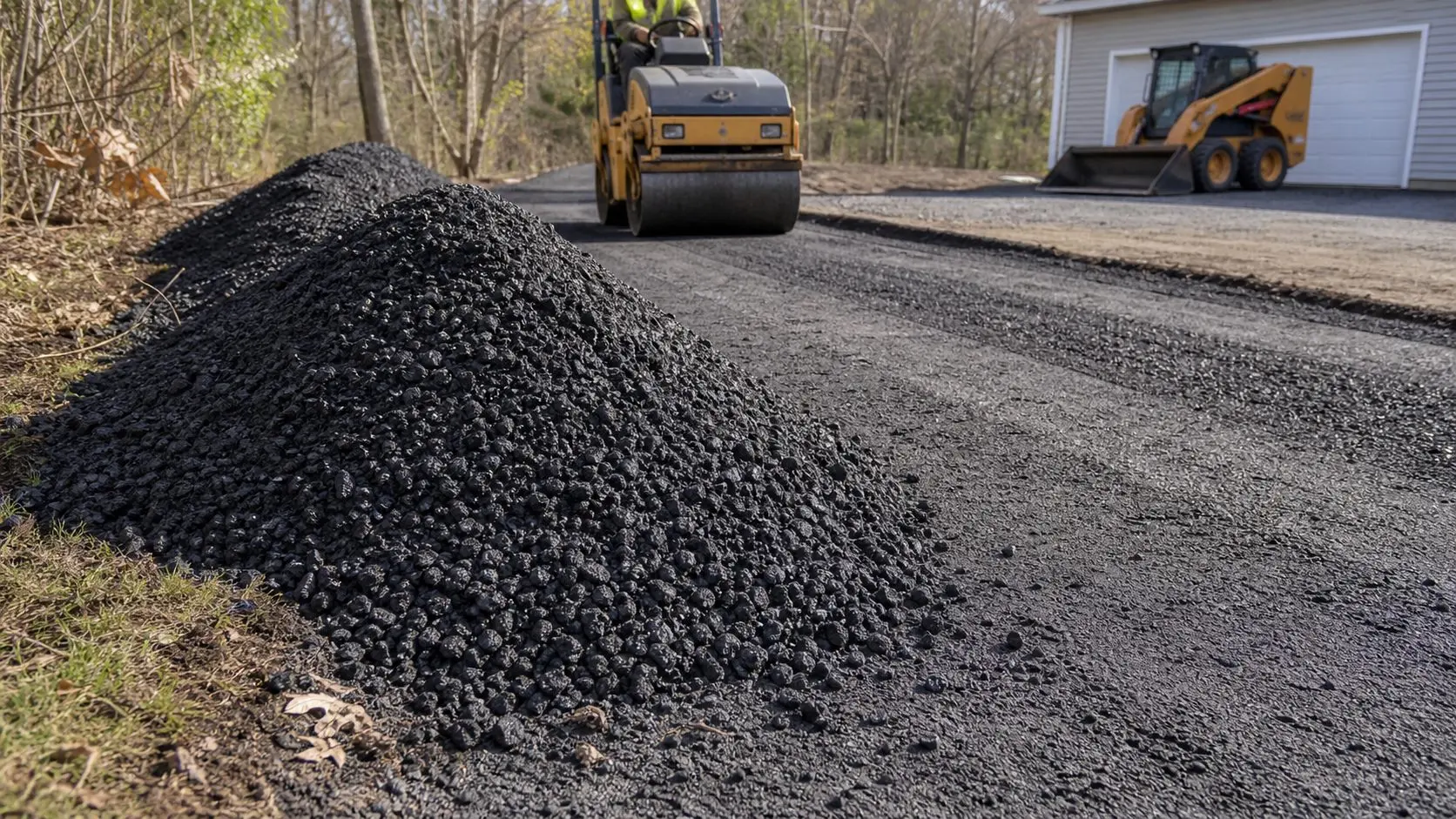
Recycled asphalt millings are one of the most popular low-cost materials for driveways, farm roads, parking areas, temporary access roads, and resurfacing projects.
They are also called:
- Asphalt millings
- Recycled asphalt
- RAP
- Reclaimed asphalt pavement
- Crushed asphalt
- Asphalt grindings
The material comes from old asphalt pavement that has been milled, crushed, screened, or reused. It still contains stone aggregate and old bitumen binder, which can help the material compact into a firm surface.
But before ordering, one question matters most:
How many tons of asphalt millings do you need?
The quick answer is:
To calculate recycled asphalt millings, multiply the area by the depth to get volume, then multiply by the material density to get weight. For rough estimates, 1 cubic yard of asphalt millings often weighs around 1.2 to 1.6 tons, depending on moisture, gradation, and compaction.
This guide explains how to calculate asphalt millings tons, coverage, cost, truckloads, and depth using simple formulas, examples, and tables.
For fast estimates, you can use the Asphalt Tonnage Calculator or Asphalt Material Calculator on BitumenCalc.
Quick Answer: How Do You Calculate Asphalt Millings?
To calculate asphalt millings, use this formula:
For imperial units:
For cubic yards:
A practical rough estimate is:
A common planning value is:
For metric units:
Because asphalt millings vary, always confirm density or tons-per-yard values with your supplier when possible.
What Are Asphalt Millings?
Asphalt millings are recycled pieces of old asphalt pavement.
They are produced when a milling machine removes the top layer of an asphalt road, driveway, or parking lot. The removed material is then collected, transported, and reused.
Asphalt millings contain:
- Crushed stone aggregate
- Sand and fines
- Old bitumen binder
- Different particle sizes
- Sometimes moisture
- Sometimes dust or loose fines
Because the material already contains asphalt binder, it can compact better than plain gravel in many applications.
Why Use Recycled Asphalt Millings?
Asphalt millings are popular because they can be cheaper than new asphalt and more stable than loose gravel when compacted properly.
Common benefits include:
- Lower material cost
- Reuse of old pavement
- Good compaction
- Reduced dust compared with gravel
- Better appearance than loose stone
- Useful for driveways and access roads
- Can harden over time under traffic and heat
- Less waste sent to landfill
They are not always equal to hot mix asphalt, but they can be a practical option for many low to medium-use surfaces.
Common Uses of Asphalt Millings
Asphalt millings can be used in many projects.
| Use Case | Suitability |
|---|---|
| Residential driveways | Very common |
| Farm roads | Common |
| Temporary access roads | Common |
| Parking areas | Common |
| Road shoulders | Common |
| Pothole filling | Sometimes |
| Base material | Sometimes |
| Construction yards | Common |
| Private roads | Common |
| Heavy-duty truck areas | Needs stronger design |
For heavy commercial or public road use, project specifications and engineering design are important.
Asphalt Millings vs New Asphalt
Asphalt millings and new hot mix asphalt are different materials.
| Feature | Asphalt Millings | New Hot Mix Asphalt |
|---|---|---|
| Material source | Recycled old asphalt | New asphalt mix |
| Cost | Usually lower | Usually higher |
| Finish | Rougher | Smoother |
| Binder | Existing aged binder | New binder |
| Installation | Often spread and compacted | Placed hot and compacted |
| Strength | Good for many light uses | Higher and more predictable |
| Appearance | Dark gray/black, textured | Smooth black finish |
| Best use | Driveways, roads, parking areas | Roads, commercial paving, finished surfaces |
Millings can be a strong and economical choice, but they should not be confused with a professionally paved hot mix asphalt surface.
Asphalt Millings Calculator Formula
The main formula is:
Then:
Then:
For cubic yards:
when length, width, and depth are in feet.
Then:
This method is easy because many suppliers sell or estimate millings by cubic yard or ton.
Step 1: Measure the Area
For a rectangular driveway or parking area:
Example:
For irregular areas, divide the space into smaller shapes.
Common sections include:
- Main driveway
- Parking pad
- Turnaround area
- Entrance apron
- Side strip
- Widened section
- Curved approach
Calculate each section separately, then add them together.
Step 2: Choose the Depth
Depth is one of the biggest factors in asphalt millings quantity.
Common depth ranges:
| Use Case | Common Millings Depth |
|---|---|
| Light driveway top layer | 2 in |
| Standard driveway | 3–4 in |
| Parking area | 3–5 in |
| Farm road | 4–6 in |
| Access road | 4–6 in |
| Heavy-use area | 6+ in, with proper base |
| Thin resurfacing | 1.5–2 in |
For many residential driveways, 3 to 4 inches is a common planning depth.
A thinner layer may not compact well or last long. A thicker layer needs more material and cost.
Step 3: Convert Depth Correctly
If using feet-based formulas, convert inches to feet.
Examples:
| Depth | Feet |
|---|---|
| 2 in | 0.167 ft |
| 3 in | 0.25 ft |
| 4 in | 0.333 ft |
| 5 in | 0.417 ft |
| 6 in | 0.5 ft |
For metric:
Examples:
| Depth | Meters |
|---|---|
| 50 mm | 0.05 m |
| 75 mm | 0.075 m |
| 100 mm | 0.10 m |
| 125 mm | 0.125 m |
| 150 mm | 0.15 m |
Wrong depth conversion is one of the most common calculation mistakes.
Step 4: Use the Right Density
Asphalt millings density can vary more than new asphalt.
It depends on:
- Particle size
- Moisture content
- Compaction
- Amount of fines
- Old binder content
- Source material
- Stockpile condition
- Screening and crushing
A common rough density range is:
A practical planning value is:
For metric estimates, recycled asphalt millings may be roughly:
depending on material condition and compaction.
For accurate ordering, use the supplier’s value.
Asphalt Millings Tons per Cubic Yard
The most useful field conversion is tons per cubic yard.
| Material Condition | Approx. Tons per Cubic Yard |
|---|---|
| Loose, dry millings | 1.2–1.3 tons/yd³ |
| Typical millings | 1.3–1.5 tons/yd³ |
| Moist or dense millings | 1.5–1.6 tons/yd³ |
| Highly compacted estimate | Can vary by project |
For quick estimates:
If your supplier says 1.5 tons per cubic yard, use 1.5.
Asphalt Millings Coverage per Ton
Coverage depends on depth and density.
Using 1.4 tons per cubic yard:
Since:
One ton volume:
Coverage formula:
Coverage Table per Ton
Using 1.4 tons per cubic yard:
| Depth | Approx. Coverage per Ton |
|---|---|
| 2 in | 116 ft² |
| 3 in | 77 ft² |
| 4 in | 58 ft² |
| 5 in | 46 ft² |
| 6 in | 39 ft² |
This is a planning estimate. Real coverage depends on density, spreading loss, and compaction.
Asphalt Millings Tons by Area and Depth
Using 1.4 tons per cubic yard:
| Area | 2 in | 3 in | 4 in | 6 in |
|---|---|---|---|---|
| 500 ft² | 4.3 tons | 6.5 tons | 8.6 tons | 13.0 tons |
| 1,000 ft² | 8.6 tons | 13.0 tons | 17.3 tons | 25.9 tons |
| 1,500 ft² | 13.0 tons | 19.4 tons | 25.9 tons | 38.9 tons |
| 2,000 ft² | 17.3 tons | 25.9 tons | 34.6 tons | 51.9 tons |
| 5,000 ft² | 43.2 tons | 64.8 tons | 86.4 tons | 129.6 tons |
| 10,000 ft² | 86.4 tons | 129.6 tons | 172.8 tons | 259.3 tons |
These values are rounded.
For a driveway, use the actual length, width, and depth for better accuracy.
Example 1: Asphalt Millings Driveway Calculator
Project data:
- Length: 100 ft
- Width: 12 ft
- Depth: 4 inches
- Density: 1.4 tons/yd³
- Waste: 5%
Step 1: Calculate Area
Step 2: Convert Depth
Step 3: Calculate Cubic Feet
Step 4: Convert to Cubic Yards
Step 5: Convert to Tons
Step 6: Add Waste
Final estimated quantity:
So, a 100 ft × 12 ft driveway at 4 inches deep may need about 22 tons of asphalt millings.
Example 2: Asphalt Millings Parking Area
Project data:
- Area: 2,500 ft²
- Depth: 3 inches
- Density: 1.4 tons/yd³
- Waste: 5%
Convert Depth
Volume in Cubic Feet
Cubic Yards
Tons
Add Waste
Final estimated quantity:
Example 3: Asphalt Millings in Metric Units
Project data:
- Length: 30 m
- Width: 4 m
- Depth: 100 mm
- Density: 1,800 kg/m³
- Waste: 5%
Calculate Area
Convert Depth
Calculate Volume
Convert to Metric Tons
Add Waste
Final estimated quantity:
Example 4: Long Farm Road Calculation
Project data:
- Length: 500 ft
- Width: 10 ft
- Depth: 4 inches
- Density: 1.4 tons/yd³
Area
Depth
Volume
Cubic Yards
Tons
With 5% waste:
Final estimate:
Long roads need a lot of material, even at moderate depth.
Recycled Asphalt Millings Cost Formula
After calculating tons, cost is simple.
If price is per cubic yard:
Example:
- Quantity: 22 tons
- Price: 25 per ton
Estimated material cost:
If delivery is separate, add delivery cost.
Asphalt Millings Cost Table
This table uses example price ranges only. Replace with your local supplier price.
| Quantity | At 20/Ton | At 30/Ton | At 40/Ton |
|---|---|---|---|
| 10 tons | 200 | 300 | 400 |
| 20 tons | 400 | 600 | 800 |
| 30 tons | 600 | 900 | 1,200 |
| 50 tons | 1,000 | 1,500 | 2,000 |
| 100 tons | 2,000 | 3,000 | 4,000 |
| 200 tons | 4,000 | 6,000 | 8,000 |
Material price changes by region, supplier, quantity, transport distance, and availability.
Use the Asphalt Cost Calculator if you want to calculate cost from tons and unit price.
Installed Cost vs Material-Only Cost
Material-only cost is not the full project cost.
A complete asphalt millings project may include:
- Material
- Delivery
- Grading
- Base preparation
- Spreading
- Watering, if needed
- Compaction
- Equipment rental
- Labor
- Edge shaping
- Drainage correction
A cheap material price does not always mean a cheap finished project.
For driveways and private roads, compaction and grading can make a big difference in performance.
How Many Truckloads of Asphalt Millings Do You Need?
Truckloads depend on total tons and truck capacity.
Formula:
Example:
- Total quantity: 22 tons
- Truck capacity: 10 tons
You may need 3 truckloads, depending on delivery rules.
| Total Tons | 10-Ton Truck | 15-Ton Truck | 20-Ton Truck |
|---|---|---|---|
| 20 tons | 2 loads | 2 loads | 1 load |
| 50 tons | 5 loads | 4 loads | 3 loads |
| 100 tons | 10 loads | 7 loads | 5 loads |
| 200 tons | 20 loads | 14 loads | 10 loads |
Always confirm truck capacity with the supplier.
Asphalt Millings Depth Guide
Choosing the right depth depends on the use.
| Project Type | Suggested Depth |
|---|---|
| Light resurfacing | 1.5–2 in |
| Residential driveway | 3–4 in |
| Parking pad | 3–5 in |
| Farm road | 4–6 in |
| Private access road | 4–6 in |
| Heavy-use area | 6+ in with strong base |
Depth should be greater if the surface carries heavier vehicles or if the base is weak.
For light use, 2 inches may work as a top layer. For a longer-lasting driveway, 3 to 4 inches is often more practical.
Do Asphalt Millings Need a Base?
A base is important.
Millings can perform well over a stable surface, but they are not magic. If the ground underneath is soft, wet, or uneven, the millings may shift, rut, or sink.
A good base helps with:
- Load support
- Drainage
- Compaction
- Surface stability
- Long-term performance
- Reduced rutting
- Reduced potholes
For best results, prepare the base before spreading millings.
Base Preparation Checklist
Before placing asphalt millings, check:
- Remove soft soil
- Grade the surface
- Correct drainage slope
- Compact the subgrade
- Add aggregate base if needed
- Remove mud and organic material
- Shape edges
- Avoid standing water
- Plan the final elevation
- Compact in layers if depth is high
A strong base can make recycled asphalt millings last much longer.
How to Install Asphalt Millings
Basic installation steps:
1. Measure the area.
2. Calculate required tons.
3. Prepare the base.
4. Grade and shape the surface.
5. Spread millings evenly.
6. Maintain correct depth.
7. Add water if needed for compaction.
8. Compact with a roller or plate compactor.
9. Shape edges and drainage.
10. Allow traffic to help tighten the surface over time.
The final surface quality depends on material quality, grading, moisture, and compaction.
Should Asphalt Millings Be Compacted?
Yes.
Compaction is very important.
Loose millings may shift, create dust, or rut under traffic. Compacted millings can become much firmer and more stable.
Compaction helps:
- Reduce air voids
- Lock particles together
- Improve surface strength
- Reduce loose material
- Improve appearance
- Improve load support
Use a roller for larger areas. A plate compactor may work for small areas.
Asphalt Millings Compaction Factor
Millings can reduce in thickness after compaction.
For example, a loose 4-inch layer may compact down to around 3 to 3.5 inches depending on material and compaction effort.
That means you may need to place slightly more loose material to reach the final compacted depth.
Because compaction varies, ask the supplier or contractor for local guidance.
A waste or compaction allowance can help avoid shortages.
Asphalt Millings vs Gravel
Both asphalt millings and gravel are used for driveways and roads.
| Feature | Asphalt Millings | Gravel |
|---|---|---|
| Cost | Often affordable | Usually affordable |
| Dust | Often less when compacted | Can be dusty |
| Binder | Contains old asphalt binder | No binder |
| Surface | Can compact firm | Loose unless stabilized |
| Appearance | Darker, asphalt-like | Stone color |
| Maintenance | Moderate | Moderate to high |
| Drainage | Depends on grading | Usually good |
| Heat effect | Can tighten in warm weather | No binder activation |
Asphalt millings may feel more solid than gravel after compaction, but gravel may drain better depending on gradation and base design.
Asphalt Millings vs Crushed Concrete
Crushed concrete is another recycled material.
| Feature | Asphalt Millings | Crushed Concrete |
|---|---|---|
| Source | Old asphalt pavement | Demolished concrete |
| Binder | Old bitumen | Cementitious material |
| Color | Dark gray/black | Light gray |
| Compaction | Good | Good |
| Dust | Moderate | Can be dusty |
| Best use | Driveways, roads, parking | Base, driveways, roads |
| Surface feel | Asphalt-like | Gravel-like |
The better option depends on availability, price, drainage, and project purpose.
Are Asphalt Millings Good for Driveways?
Yes, asphalt millings can be good for driveways when installed properly.
They are especially useful for:
- Long rural driveways
- Farm access roads
- Budget driveways
- Temporary surfaces
- Parking pads
- Private roads
But the performance depends on:
- Base condition
- Depth
- Compaction
- Drainage
- Material quality
- Traffic load
- Climate
A thin layer over soft soil will not perform well. A properly graded and compacted layer over a stable base can work much better.
Can You Seal Asphalt Millings?
Some people seal or treat asphalt millings to improve bonding and appearance.
Options may include:
- Compaction only
- Water and rolling
- Asphalt rejuvenator
- Fog seal, where appropriate
- Surface treatment
- Additional binder, if specified
The right method depends on the project and local rules.
Do not apply products randomly without knowing compatibility and environmental requirements.
How Long Do Asphalt Millings Last?
Asphalt millings can last for years when properly installed.
Life depends on:
- Traffic load
- Thickness
- Base quality
- Drainage
- Compaction
- Weather
- Maintenance
- Material quality
A properly compacted driveway with good drainage can perform well for a long time. A poorly prepared surface can fail quickly.
Maintenance may include grading, filling low spots, adding more millings, and compacting again.
Common Asphalt Millings Calculation Mistakes
| Mistake | Result |
|---|---|
| Using area only | No depth included |
| Forgetting to convert inches to feet | Wrong volume |
| Using new asphalt density for millings | Quantity may be wrong |
| Ignoring compaction | Final depth may be low |
| No waste allowance | Material shortage risk |
| Not checking supplier tons/yard | Wrong ordering quantity |
| Ignoring base condition | Rutting and settlement |
| Not compacting | Loose unstable surface |
| Poor drainage | Soft spots and potholes |
The biggest mistake is treating millings exactly like new hot mix asphalt. They are related, but not the same.
Asphalt Millings Calculator Inputs
A useful asphalt millings calculator should include:
| Input | Example |
|---|---|
| Length | 100 ft |
| Width | 12 ft |
| Area | 1,200 ft² |
| Depth | 4 in |
| Tons per cubic yard | 1.4 |
| Waste percentage | 5% |
| Price per ton | Optional |
| Truck capacity | Optional |
It should calculate:
- Area
- Cubic feet
- Cubic yards
- Tons
- Waste-adjusted tons
- Cost
- Truckloads
- Coverage
If your supplier provides density in lb/ft³ or kg/m³, use that value for better accuracy.
Manual Calculation Template
Use this simple template.
| Item | Value |
|---|---|
| Length | ___ |
| Width | ___ |
| Area | ___ |
| Depth | ___ |
| Cubic feet | ___ |
| Cubic yards | ___ |
| Tons per cubic yard | ___ |
| Tons required | ___ |
| Waste % | ___ |
| Final tons | ___ |
| Price per ton | ___ |
| Estimated cost | ___ |
Formula:
Recommended Featured Snippet Answer
Use this near the top of the blog:
To calculate asphalt millings, multiply the area by depth to get volume, convert the volume to cubic yards, then multiply by the tons per cubic yard. A common estimate is 1 cubic yard of asphalt millings equals about 1.4 tons, but the actual value can range from 1.2 to 1.6 tons depending on moisture, gradation, and compaction.
This answer is direct, useful, and calculator-focused.
FAQ: Asphalt Millings Calculator
1. How do you calculate asphalt millings?
Calculate the area, multiply by depth to get volume, convert volume to cubic yards, then multiply by tons per cubic yard.
2. How many tons are in a cubic yard of asphalt millings?
Asphalt millings often weigh around 1.2 to 1.6 tons per cubic yard. A common planning estimate is 1.4 tons per cubic yard.
3. How much area does 1 ton of asphalt millings cover?
Using 1.4 tons per cubic yard, 1 ton covers about 77 ft² at 3 inches deep or about 58 ft² at 4 inches deep.
4. How deep should asphalt millings be for a driveway?
A common depth for an asphalt millings driveway is 3 to 4 inches. Heavier-use areas may need 4 to 6 inches or more with a strong base.
5. How many tons of millings do I need for a 100 ft by 12 ft driveway?
At 4 inches deep and 1.4 tons per cubic yard, a 100 ft × 12 ft driveway needs about 21 tons before waste, or about 22 tons with 5% waste.
6. Are asphalt millings cheaper than new asphalt?
Usually yes. Asphalt millings are commonly cheaper than new hot mix asphalt, but prices vary by location, supplier, delivery distance, and availability.
7. Do asphalt millings need compaction?
Yes. Compaction helps lock the material together and creates a firmer, more stable surface.
8. Do asphalt millings harden over time?
They can tighten and firm up under heat, traffic, and compaction because they contain old asphalt binder. But they do not perform exactly like new hot mix asphalt.
9. Can asphalt millings be used over dirt?
They can be placed over dirt, but performance is much better if the ground is stable, graded, compacted, and properly drained. Soft or wet soil can cause rutting.
10. Should I add waste when ordering asphalt millings?
Yes. A 5% waste allowance is common for many projects. Irregular shapes, soft base, or heavy compaction may require more.
11. How many truckloads of asphalt millings do I need?
Divide total tons by truck capacity.
If you need 50 tons and the truck carries 20 tons, you need about 3 truckloads.
12. Are asphalt millings the same as recycled asphalt?
They are often used to mean the same thing. Asphalt millings are a form of recycled asphalt created when old pavement is milled and reused.
Final Thoughts
Recycled asphalt millings can be a cost-effective material for driveways, farm roads, parking areas, access roads, and resurfacing projects.
The calculation is simple:
For rough planning, remember:
But actual density can vary from about 1.2 to 1.6 tons per cubic yard depending on moisture, gradation, and compaction.
For best results, measure carefully, choose the right depth, prepare the base, compact the material properly, and confirm material density with your supplier.
Use the Asphalt Tonnage Calculator or Asphalt Material Calculator on BitumenCalc to estimate recycled asphalt millings tons, coverage, and cost more easily.