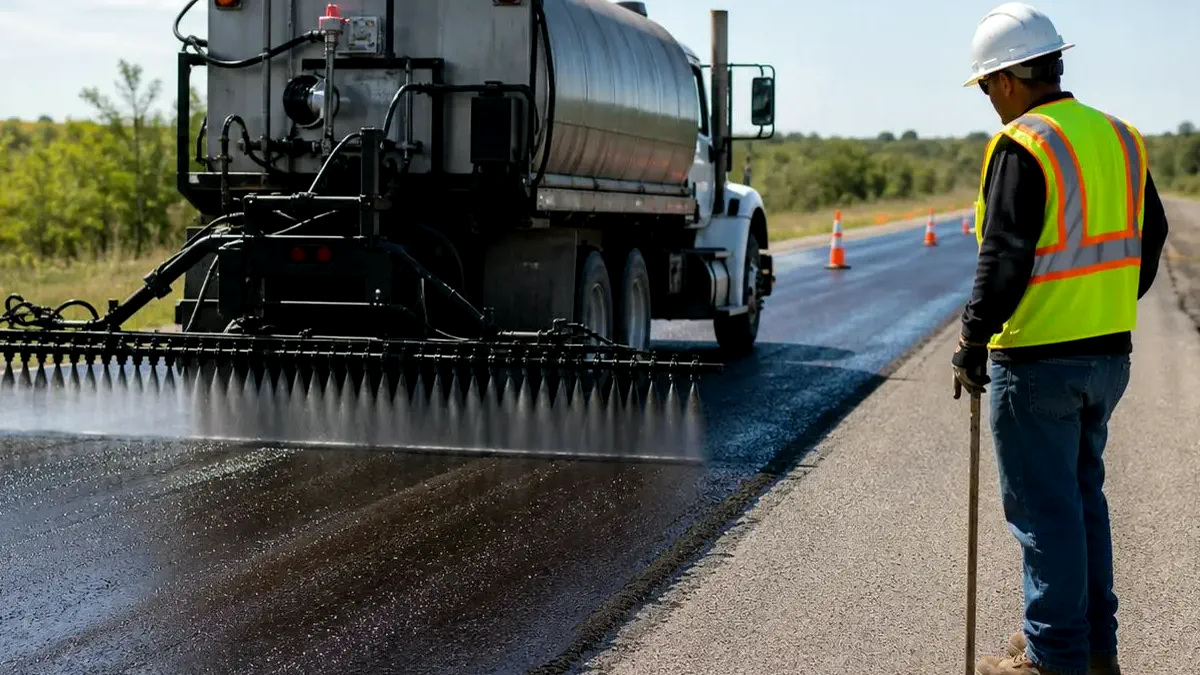
Prime coat and tack coat are two important layers in asphalt road construction.
They both use bituminous material.
They both are applied before another pavement layer.
They both help improve pavement performance.
But they are not the same.
The main difference is simple:
Prime coat is applied on a granular base before asphalt paving. Tack coat is applied between asphalt layers or on an existing paved surface to bond the next asphalt layer.
Prime coat prepares and seals the base. Tack coat bonds pavement layers together.
If you confuse the two, the pavement may fail early. A prime coat cannot always replace a tack coat. A tack coat cannot properly do the job of a prime coat on a granular base.
This guide explains the difference between prime coat and tack coat in simple language. You will also learn typical application rates, formulas, quantity calculations, examples, tables, and common mistakes.
For related quantity calculations, you can use the Tack Coat Calculator or the Bitumen Calculator on BitumenCalc.
Quick Answer: What Is the Difference Between Prime Coat and Tack Coat?
Prime coat is applied to a prepared granular base before placing the first asphalt layer. Its job is to penetrate the base, bind loose particles, seal the surface, and improve adhesion between the base and asphalt.
Tack coat is applied between asphalt layers or over an existing paved surface. Its job is to bond the new asphalt layer to the old layer.
| Item | Prime Coat | Tack Coat |
|---|---|---|
| Applied on | Granular base or unbound base | Existing asphalt, concrete, or asphalt layer |
| Main purpose | Penetration, sealing, and base bonding | Bonding between pavement layers |
| Typical material | Bitumen emulsion or cutback bitumen, depending on specification | Bitumen emulsion or asphalt binder |
| Application rate | Usually higher | Usually lower |
| Surface type | Unbound granular surface | Bound paved surface |
| Used before | First asphalt layer | Asphalt overlay or next asphalt course |
| Main failure if missed | Poor base bond, moisture entry, loose base | Layer separation, slippage, delamination |
In short:
What Is Prime Coat?
Prime coat is a bituminous layer applied on a prepared granular base before the first asphalt layer is placed.
It is usually sprayed over:
- Crushed stone base
- Granular road base
- Water-bound macadam
- Unbound aggregate base
- Prepared sub-base, when specified
Prime coat helps the base surface become ready for asphalt paving.
It can:
- Penetrate the base surface
- Bind loose particles
- Seal surface pores
- Reduce water entry
- Improve adhesion between base and asphalt
- Stabilize the top of the granular layer
- Prepare the base for asphalt placement
Prime coat is especially important when the base is dry, open-textured, dusty, or porous.
What Is Tack Coat?
Tack coat is a thin bituminous layer applied between pavement layers.
It is usually sprayed over:
- Existing asphalt
- New asphalt binder course
- Milled asphalt surface
- Asphalt base course
- Concrete surface, if specified
- Patch repair surfaces
- Old pavement before overlay
The purpose of tack coat is not to penetrate deeply. Its job is to create a sticky bond between two layers.
Tack coat helps the upper asphalt layer and lower layer act together as one pavement structure.
Without tack coat, layers may slip, separate, or crack.
Prime Coat vs Tack Coat: Simple Explanation
Think of pavement like a layered system.
Prime coat prepares the foundation surface before asphalt starts.
Tack coat sticks asphalt layers together after the first layer already exists.
| Simple Example | Correct Coat |
|---|---|
| Asphalt over crushed stone base | Prime coat |
| Asphalt overlay over old asphalt | Tack coat |
| Surface course over binder course | Tack coat |
| First asphalt layer over granular base | Prime coat |
| Patch repair over existing asphalt edge | Tack coat |
| Asphalt over milled road surface | Tack coat |
| Asphalt over dry open granular base | Prime coat |
A helpful memory rule:
Why Prime Coat Is Used
Prime coat is used because a granular base is not the same as asphalt.
A granular base may contain dust, small voids, and loose particles. It may absorb water. It may not bond well with asphalt unless properly prepared.
Prime coat helps create a better transition between the base and asphalt.
Main benefits of prime coat:
- Seals the base surface
- Reduces dust
- Binds loose aggregate particles
- Helps asphalt bond to the base
- Reduces moisture movement
- Improves stability of the top base layer
- Helps prevent base disturbance during paving
A good prime coat can improve the life of the first asphalt layer.
Why Tack Coat Is Used
Tack coat is used because asphalt layers must bond.
A road may look like one solid layer from the top, but it is often built in multiple layers. If those layers do not bond, they may move separately under traffic.
That movement can cause pavement failure.
Tack coat helps prevent:
- Slippage cracks
- Delamination
- Shoving
- Potholes
- Poor load transfer
- Layer separation
- Overlay failure
- Surface movement under braking or turning traffic
A properly applied tack coat helps the full asphalt structure work as one unit.
Prime Coat Application Rate
Prime coat application rate depends on base type, porosity, material, and project specification.
Common planning range:
For some very open or dry bases, the rate may be higher. For dense, tight bases, the rate may be lower.
| Base Surface Type | Typical Prime Coat Rate |
|---|---|
| Dense granular base | 0.7–1.0 L/m² |
| Standard crushed aggregate base | 1.0–1.2 L/m² |
| Open-textured base | 1.2–1.5 L/m² |
| Very dry or porous base | 1.5+ L/m², if specified |
These are general estimating ranges. Always follow the project specification or engineer’s instruction.
Tack Coat Application Rate
Tack coat is usually applied at a lower rate than prime coat because it is applied over a bound surface.
Common planning range:
| Surface Type | Typical Tack Coat Rate |
|---|---|
| New asphalt | 0.20–0.35 L/m² |
| Existing asphalt | 0.30–0.50 L/m² |
| Milled asphalt | 0.40–0.70 L/m² |
| Concrete surface | 0.35–0.60 L/m² |
| Dry or porous asphalt | 0.50–0.70 L/m² |
Milled surfaces often require more tack coat because they are rougher and have more surface texture.
Prime Coat vs Tack Coat Application Rate Table
| Feature | Prime Coat | Tack Coat |
|---|---|---|
| Common metric rate | 0.7–1.5 L/m² | 0.20–0.70 L/m² |
| Common imperial rate | Approx. 0.15–0.35 gal/yd² | Approx. 0.04–0.15 gal/yd² |
| Rate level | Higher | Lower |
| Surface absorption | Higher | Lower to medium |
| Main control factor | Base porosity | Surface texture and residual binder |
| Typical quantity | More material | Less material |
Prime coat is generally heavier because it must penetrate and seal a granular base. Tack coat is lighter because it mainly creates a bonding film.
Prime Coat Calculation Formula
The basic formula is:
For metric:
Example:
- Area: 2,000 m²
- Prime coat rate: 1.0 L/m²
If adding 5% waste:
Final quantity: 2,100 liters
Tack Coat Calculation Formula
The tack coat formula is also:
For metric:
Example:
- Area: 2,000 m²
- Tack coat rate: 0.40 L/m²
If adding 5% waste:
Final quantity: 840 liters
The area may be the same, but the rate is different. That is why prime coat often needs more material.
Prime Coat and Tack Coat Formula in Imperial Units
For imperial projects:
If your area is in square feet:
Example:
- Area: 18,000 ft²
- Tack coat rate: 0.08 gal/yd²
Convert area:
Calculate quantity:
For prime coat at 0.25 gal/yd²:
Same area. Different rate. Different quantity.
Prime Coat Quantity Table
This table uses common metric rates.
| Area | 0.7 L/m² | 1.0 L/m² | 1.2 L/m² | 1.5 L/m² |
|---|---|---|---|---|
| 100 m² | 70 L | 100 L | 120 L | 150 L |
| 500 m² | 350 L | 500 L | 600 L | 750 L |
| 1,000 m² | 700 L | 1,000 L | 1,200 L | 1,500 L |
| 2,500 m² | 1,750 L | 2,500 L | 3,000 L | 3,750 L |
| 5,000 m² | 3,500 L | 5,000 L | 6,000 L | 7,500 L |
| 10,000 m² | 7,000 L | 10,000 L | 12,000 L | 15,000 L |
Use higher rates for more porous bases only when specified.
Tack Coat Quantity Table
This table uses common metric tack coat rates.
| Area | 0.25 L/m² | 0.35 L/m² | 0.50 L/m² | 0.70 L/m² |
|---|---|---|---|---|
| 100 m² | 25 L | 35 L | 50 L | 70 L |
| 500 m² | 125 L | 175 L | 250 L | 350 L |
| 1,000 m² | 250 L | 350 L | 500 L | 700 L |
| 2,500 m² | 625 L | 875 L | 1,250 L | 1,750 L |
| 5,000 m² | 1,250 L | 1,750 L | 2,500 L | 3,500 L |
| 10,000 m² | 2,500 L | 3,500 L | 5,000 L | 7,000 L |
Tack coat quantity is usually lower than prime coat quantity for the same area.
Example 1: Prime Coat Calculation for Road Base
Project data:
- Road length: 500 m
- Width: 7 m
- Prime coat rate: 1.0 L/m²
- Waste: 5%
Step 1: Calculate Area
Step 2: Calculate Prime Coat
Step 3: Add Waste
Final estimated prime coat quantity:
Example 2: Tack Coat Calculation for Asphalt Overlay
Project data:
- Overlay area: 3,500 m²
- Existing surface: Old asphalt
- Tack coat rate: 0.40 L/m²
- Waste: 5%
Step 1: Calculate Tack Coat
Step 2: Add Waste
Final estimated tack coat quantity:
For the same area, the prime coat required 3,675 liters, while tack coat required 1,470 liters.
Example 3: Prime Coat vs Tack Coat for the Same Area
Suppose the area is:
Prime coat rate:
Tack coat rate:
Prime coat quantity:
Tack coat quantity:
Difference:
Prime coat uses much more material because the base surface absorbs and needs sealing.
Example 4: Imperial Prime Coat and Tack Coat Calculation
Project data:
- Area: 27,000 ft²
- Prime coat rate: 0.25 gal/yd²
- Tack coat rate: 0.08 gal/yd²
Convert ft² to yd²:
Prime coat:
Tack coat:
This shows the difference clearly.
Same area. Different purpose. Different material rate.
When Should You Use Prime Coat?
Use prime coat when asphalt is being placed over a prepared granular base and the specification requires it.
Common situations:
- New road construction
- New driveway over aggregate base
- First asphalt layer over crushed stone
- First asphalt layer over granular sub-base
- Base surface is dry or dusty
- Base needs sealing before asphalt
- Project specification requires prime coat
Prime coat is normally not used between two asphalt layers. That is tack coat’s job.
When Should You Use Tack Coat?
Use tack coat when asphalt is being placed over a bound surface.
Common situations:
- Asphalt overlay over existing asphalt
- Surface course over binder course
- Asphalt layer over milled pavement
- Patch repair on asphalt edge
- Asphalt over concrete, if specified
- New layer over an asphalt base course
- Road resurfacing work
Tack coat is usually required between asphalt courses to create proper bonding.
Prime Coat on Granular Base
A granular base can be dusty, porous, or loose at the surface.
Prime coat helps by penetrating the upper surface and binding fine particles.
Before applying prime coat, the base should be:
- Properly graded
- Compacted
- Clean
- Slightly moist if specified
- Free from loose dust
- At correct level
- Approved for paving
Too much dust can prevent proper penetration. Too much water can also affect performance.
The base should be ready before spraying.
Tack Coat on Existing Asphalt
Existing asphalt should be clean before tack coat application.
Remove:
- Dust
- Mud
- Loose aggregate
- Oil
- Standing water
- Debris
- Excessive loose millings
A clean surface helps the tack coat bond properly.
If the tack coat is sprayed on dust, the new asphalt may bond to the dust instead of the pavement. That creates a weak layer.
Tack Coat on Milled Surface
Milled surfaces need extra attention.
They are rough and textured. They may need more tack coat than smooth asphalt.
Reasons milled surfaces need more material:
- More surface area
- Grooves and ridges
- More texture
- Higher absorption
- More bonding demand
A low tack coat rate on a milled surface can leave parts under-coated.
For milled asphalt, a rate around 0.40 to 0.70 L/m² is often used as a planning range.
Prime Coat Curing Time
Prime coat usually needs time to penetrate and cure before asphalt is placed.
Curing time depends on:
- Material type
- Application rate
- Base porosity
- Weather
- Temperature
- Humidity
- Wind
- Specification
If asphalt is placed too soon, the prime coat may not perform correctly. If it is left exposed too long, it may become dusty, dirty, or damaged.
Always follow the project specification.
Tack Coat Breaking Time
Tack coat, especially emulsion tack coat, needs time to break.
Breaking means water separates from the emulsion and the residual bitumen becomes sticky.
Tack coat should usually be allowed to break before asphalt placement.
Breaking time depends on:
- Emulsion type
- Rate
- Temperature
- Humidity
- Wind
- Surface condition
- Dilution
- Weather
If asphalt is placed too early, bonding may be weak. If tack coat is contaminated by traffic or dust, bonding may also be poor.
Residual Bitumen in Prime Coat and Tack Coat
Many prime coats and tack coats are applied as bitumen emulsions.
Emulsion contains:
- Bitumen
- Water
- Emulsifier
After application, water leaves and residual bitumen remains.
This matters because the specified rate may refer to:
- Total emulsion application rate
- Residual bitumen rate
Formula:
Example:
- Emulsion rate: 0.50 L/m²
- Residual content: 60%
If the specification gives the required residual binder, adjust the emulsion rate.
How to Calculate Emulsion Rate from Residual Rate
Formula:
Example:
- Required residual rate: 0.25 L/m²
- Residual content: 60%
So, apply about:
This is important for tack coat and prime coat calculations when residual binder is specified.
Prime Coat vs Tack Coat Material Types
Material selection depends on local practice and project specification.
Common materials may include:
| Material | Common Use |
|---|---|
| Bitumen emulsion | Prime coat or tack coat |
| Cutback bitumen | Sometimes used for prime coat where allowed |
| Asphalt binder | Tack coat in some systems |
| Modified emulsion | Special tack coat applications |
| Slow-setting emulsion | Often used where penetration is needed |
| Rapid-setting emulsion | Often used for tack coat, depending on spec |
Environmental rules may limit or discourage some materials, especially cutbacks. Always follow local standards.
Can Tack Coat Replace Prime Coat?
Usually, no.
Tack coat is designed to bond layers. Prime coat is designed to penetrate and seal a granular base.
A tack coat may not penetrate enough into an unbound base. It may sit on top and fail to stabilize the base surface.
If the surface is granular, prime coat is normally the correct treatment when specified.
Can Prime Coat Replace Tack Coat?
Usually, no.
Prime coat is not the right bonding layer between asphalt courses.
Tack coat is designed to create a sticky bond between bound surfaces. It is normally the correct layer between asphalt courses or before overlays.
Using prime coat where tack coat is needed may cause poor bonding or unnecessary material application.
Common Mistakes with Prime Coat and Tack Coat
| Mistake | Result |
|---|---|
| Using tack coat on granular base instead of prime coat | Poor penetration and weak base bond |
| Using prime coat between asphalt layers | Poor layer bonding or wrong application |
| Applying too much tack coat | Slippage or bleeding |
| Applying too little tack coat | Delamination and weak bond |
| Spraying over dust | Poor adhesion |
| Ignoring residual binder | Wrong effective rate |
| No curing/breaking time | Poor performance |
| Using one rate for every surface | Over or under-application |
| Not calibrating spray truck | Uneven application |
The correct coat depends on the surface and purpose.
Prime Coat vs Tack Coat Cost Calculation
Cost calculation is simple once quantity is known.
Example:
Prime coat:
- Quantity: 3,000 liters
- Unit price: 1.10 per liter
Tack coat:
- Quantity: 1,200 liters
- Unit price: 1.20 per liter
Prime coat may have more quantity, but unit price can vary by material type and region.
How to Choose the Correct Coat
Use this simple rule.
| Surface | Correct Treatment |
|---|---|
| Granular base | Prime coat |
| Crushed stone base | Prime coat |
| Existing asphalt | Tack coat |
| Milled asphalt | Tack coat |
| Asphalt binder course | Tack coat |
| Asphalt surface course below new overlay | Tack coat |
| Concrete before asphalt overlay | Tack coat, if specified |
| Dusty unbound base | Prime coat after cleaning/preparation |
If the surface is unbound and granular, think prime coat.
If the surface is bound and paved, think tack coat.
Field Checklist Before Applying Prime Coat
Before prime coat, check:
- Base is compacted
- Base is at correct level
- Surface is clean
- Loose dust is controlled
- No standing water
- Correct material is selected
- Distributor is calibrated
- Weather is suitable
- Rate follows specification
- Traffic control is ready
Prime coat should not be applied randomly. The base must be ready.
Field Checklist Before Applying Tack Coat
Before tack coat, check:
- Surface is clean
- No dust or debris
- No standing water
- No oil or contamination
- Correct application rate is selected
- Emulsion type is correct
- Spray truck is calibrated
- Tack coat is allowed to break
- Surface is protected from traffic
- Asphalt placement follows at the right time
Tack coat should be applied evenly. Uneven streaks can create weak bonding zones.
Prime Coat vs Tack Coat: Quick Reference
| Question | Answer |
|---|---|
| Which comes first? | Prime coat |
| Which bonds asphalt layers? | Tack coat |
| Which is used on granular base? | Prime coat |
| Which is used before overlay? | Tack coat |
| Which usually has higher application rate? | Prime coat |
| Which is usually thinner? | Tack coat |
| Which prevents layer separation? | Tack coat |
| Which helps seal base? | Prime coat |
| Can one replace the other? | Usually no |
Calculation summary
Use this near the top of the blog:
Prime coat is applied on a granular base before the first asphalt layer to seal, bind, and prepare the base. Tack coat is applied between asphalt layers or on existing pavement to bond the next asphalt layer. Prime coat usually has a higher application rate, while tack coat is thinner and used mainly for adhesion.
This answer is direct and suitable for search snippets.
FAQ: Prime Coat vs Tack Coat
1. What is the main difference between prime coat and tack coat?
Prime coat is applied on granular base before the first asphalt layer. Tack coat is applied between asphalt layers or on existing pavement to bond the next layer.
2. Where is prime coat used?
Prime coat is used on prepared granular bases, crushed stone bases, and unbound surfaces before asphalt paving.
3. Where is tack coat used?
Tack coat is used on existing asphalt, milled asphalt, asphalt binder course, concrete surfaces if specified, and between asphalt layers.
4. What is the application rate of prime coat?
A common prime coat application rate is around 0.7 to 1.5 L/m², depending on base porosity and specification.
5. What is the application rate of tack coat?
A common tack coat rate is around 0.20 to 0.70 L/m², depending on the surface condition and specification.
6. Which uses more material, prime coat or tack coat?
Prime coat usually uses more material because it must penetrate and seal a granular base.
7. Can tack coat be used instead of prime coat?
Usually no. Tack coat is for bonding paved layers. Prime coat is for sealing and preparing a granular base.
8. Can prime coat be used instead of tack coat?
Usually no. Prime coat is not designed as the main bonding layer between asphalt courses.
9. What is the formula for prime coat quantity?
Use:
For metric:
10. What is the formula for tack coat quantity?
Use:
For metric:
11. Does tack coat need to dry before asphalt?
Tack coat emulsion usually needs to break before asphalt placement. The exact time depends on emulsion type, rate, weather, and surface condition.
12. Does prime coat need curing time?
Yes. Prime coat normally needs time to penetrate and cure before asphalt is placed. Follow project specifications.
13. What happens if tack coat is missed?
The asphalt layers may not bond properly. This can cause slippage, delamination, cracks, and early pavement failure.
14. What happens if prime coat is missed?
The first asphalt layer may not bond properly to the granular base, and moisture may enter the base more easily.
Final Thoughts
Prime coat and tack coat both improve asphalt pavement performance, but they do different jobs.
Prime coat prepares a granular base.
Tack coat bonds asphalt layers.
Use prime coat before the first asphalt layer over a base.
Use tack coat between asphalt layers or before overlays.
The calculation is simple for both:
But the correct rate depends on surface type, material, residual bitumen, dilution, and project specification.
For tack coat quantity, use the Tack Coat Calculator.
For general paving and material planning, use the Bitumen Calculator or Road Construction Calculator on BitumenCalc.
Choosing the correct coat at the correct rate can reduce pavement failure, improve bonding, and make asphalt layers perform as one strong structure.