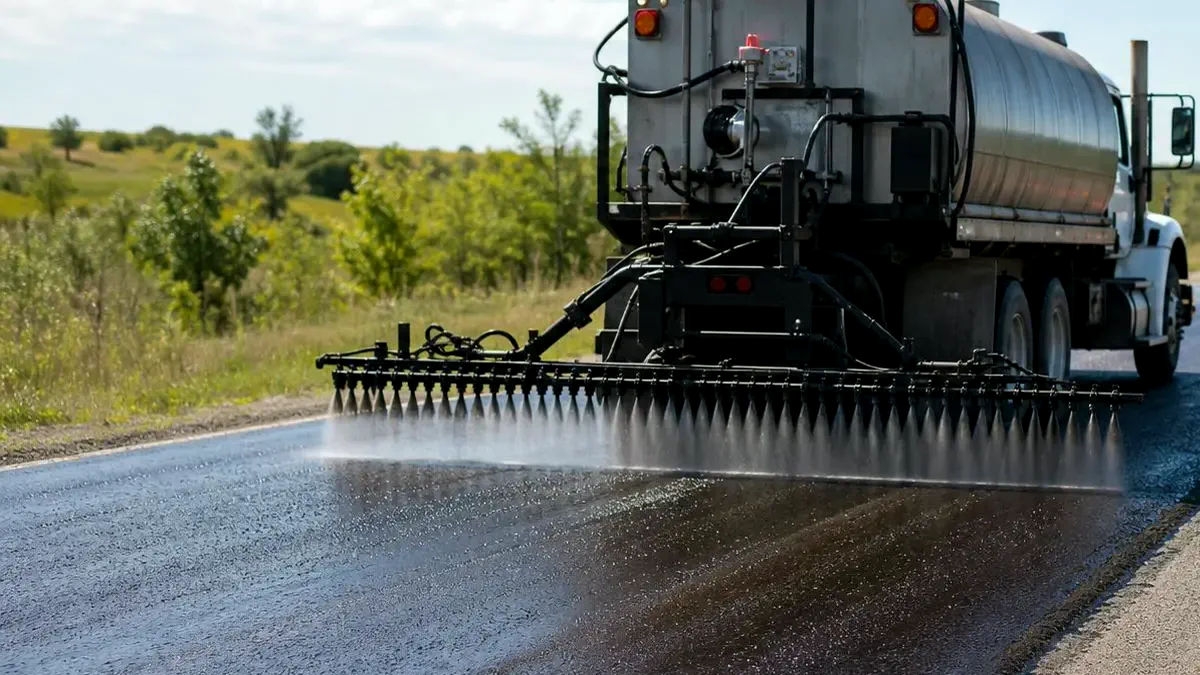
Tack coat looks like a small part of asphalt paving.
But it does a big job.
It helps bond one asphalt layer to another. Without proper tack coat, the new asphalt layer may not stick well to the old surface. That can lead to slippage, cracks, delamination, potholes, and early pavement failure.
So the question is simple:
How much tack coat do you need per m² or ft²?
The quick answer is:
Tack coat application rate commonly ranges from 0.20 to 0.70 L/m² for bitumen emulsion, depending on surface condition, emulsion type, dilution, residual bitumen, and project specification.
For imperial estimates, this is roughly:
0.04 to 0.15 gallons per square yard, depending on the tack coat material and surface.
The exact rate depends on whether the surface is new asphalt, old oxidized asphalt, milled asphalt, concrete, or a very dry and porous surface.
This guide explains how to calculate tack coat quantity with formulas, examples, tables, and practical tips.
For quick calculation, use the Tack Coat Calculator on BitumenCalc.
Quick Answer: How Do You Calculate Tack Coat Quantity?
To calculate tack coat quantity, multiply the area by the application rate.
For metric:
For imperial:
Example:
If the area is 1,000 m² and the tack coat rate is 0.40 L/m²:
So, you need approximately 400 liters of tack coat.
If you add 5% waste:
Final estimated quantity: 420 liters
What Is Tack Coat?
Tack coat is a thin layer of bitumen emulsion or asphalt binder applied between pavement layers.
Its purpose is to create a bond between:
- Old asphalt and new asphalt
- Milled asphalt and overlay
- Asphalt base course and surface course
- Asphalt binder course and wearing course
- Concrete surface and asphalt overlay, when specified
Tack coat is not meant to build thickness. It is a bonding layer.
A good tack coat helps different pavement layers behave like one strong structure. A poor tack coat can allow the top asphalt layer to slide, separate, or crack.
Why Tack Coat Is Important
Tack coat is easy to overlook because it is thin and usually applied quickly.
But it affects pavement performance.
Good tack coat helps:
- Improve layer bonding
- Reduce slippage
- Reduce delamination
- Improve pavement strength
- Improve overlay life
- Reduce cracking from poor bonding
- Support proper load transfer between layers
Poor tack coat can cause:
- Layer separation
- Surface shoving
- Slippage cracks
- Potholes
- Early overlay failure
- Weak pavement structure
- Water entry between layers
In simple words, tack coat helps the new asphalt layer stick to the layer below.
Common Tack Coat Application Rates
Tack coat rate depends on surface condition and project specification.
The table below gives general planning ranges.
| Surface Type | Approx. Tack Coat Rate |
|---|---|
| New asphalt surface | 0.20–0.35 L/m² |
| Existing asphalt surface | 0.30–0.50 L/m² |
| Milled asphalt surface | 0.40–0.70 L/m² |
| Dry or porous asphalt | 0.50–0.70 L/m² |
| Concrete surface | 0.35–0.60 L/m² |
| Patch repair area | 0.30–0.60 L/m² |
These values are general. Always follow the project specification, engineer instruction, or local authority requirement.
Tack Coat Rate in Gallons per Square Yard
In imperial paving projects, tack coat is often calculated in gallons per square yard.
Common approximate ranges:
| Surface Type | Approx. Rate |
|---|---|
| New asphalt | 0.04–0.08 gal/yd² |
| Existing asphalt | 0.06–0.11 gal/yd² |
| Milled asphalt | 0.08–0.15 gal/yd² |
| Porous surface | 0.10–0.15 gal/yd² |
| Concrete surface | 0.07–0.13 gal/yd² |
These values are approximate and depend on residual binder content, emulsion dilution, surface texture, and specification.
Tack Coat Formula in Metric Units
The metric formula is simple.
Example:
- Area: 2,500 m²
- Rate: 0.35 L/m²
So, you need 875 liters.
If waste is 5%:
Final estimated quantity: 919 liters
Tack Coat Formula in Imperial Units
The imperial formula is:
If your area is in square feet, convert to square yards first.
Example:
- Area: 18,000 ft²
- Rate: 0.08 gal/yd²
Convert area:
Calculate tack coat:
So, you need 160 gallons.
m² to ft² and yd² Conversion
When calculating tack coat, unit conversion must be correct.
| Unit Conversion | Formula |
|---|---|
| m² to ft² | m² × 10.764 |
| ft² to m² | ft² ÷ 10.764 |
| ft² to yd² | ft² ÷ 9 |
| yd² to ft² | yd² × 9 |
| m² to yd² | m² × 1.196 |
| yd² to m² | yd² ÷ 1.196 |
Wrong unit conversion can cause major material shortages or over-ordering.
Liter to Gallon Conversion
Tack coat may be measured in liters or gallons.
| Conversion | Formula |
|---|---|
| Liters to US gallons | Liters ÷ 3.785 |
| US gallons to liters | Gallons × 3.785 |
| Liters to Imperial gallons | Liters ÷ 4.546 |
| Imperial gallons to liters | Gallons × 4.546 |
Make sure you know whether the project uses US gallons or Imperial gallons.
For most online construction references, “gallon” often means US gallon unless stated otherwise.
Tack Coat Quantity Table per m²
This table shows tack coat quantity in liters for common areas.
| Area | 0.25 L/m² | 0.35 L/m² | 0.50 L/m² | 0.70 L/m² |
|---|---|---|---|---|
| 100 m² | 25 L | 35 L | 50 L | 70 L |
| 250 m² | 62.5 L | 87.5 L | 125 L | 175 L |
| 500 m² | 125 L | 175 L | 250 L | 350 L |
| 1,000 m² | 250 L | 350 L | 500 L | 700 L |
| 2,500 m² | 625 L | 875 L | 1,250 L | 1,750 L |
| 5,000 m² | 1,250 L | 1,750 L | 2,500 L | 3,500 L |
| 10,000 m² | 2,500 L | 3,500 L | 5,000 L | 7,000 L |
This is useful for quick planning before using a calculator.
Tack Coat Quantity Table per Square Yard
This table shows tack coat quantity in gallons for common areas.
| Area | 0.05 gal/yd² | 0.08 gal/yd² | 0.10 gal/yd² | 0.15 gal/yd² |
|---|---|---|---|---|
| 100 yd² | 5 gal | 8 gal | 10 gal | 15 gal |
| 250 yd² | 12.5 gal | 20 gal | 25 gal | 37.5 gal |
| 500 yd² | 25 gal | 40 gal | 50 gal | 75 gal |
| 1,000 yd² | 50 gal | 80 gal | 100 gal | 150 gal |
| 2,500 yd² | 125 gal | 200 gal | 250 gal | 375 gal |
| 5,000 yd² | 250 gal | 400 gal | 500 gal | 750 gal |
| 10,000 yd² | 500 gal | 800 gal | 1,000 gal | 1,500 gal |
Higher rates are common on rough or milled surfaces.
Example 1: Tack Coat for Asphalt Overlay in m²
Project data:
- Area: 1,500 m²
- Surface: Existing asphalt
- Tack coat rate: 0.35 L/m²
- Waste: 5%
Calculate base quantity
Add waste
Final estimated tack coat quantity:
So, you may plan for approximately 550 liters.
Example 2: Tack Coat for Milled Surface
Milled asphalt surfaces are rougher and more open textured. They usually need a higher tack coat rate.
Project data:
- Area: 3,000 m²
- Surface: Milled asphalt
- Rate: 0.60 L/m²
- Waste: 5%
Calculate quantity
Add waste
Final estimated quantity:
A milled surface can absorb more material, so using too low a rate may reduce bonding.
Example 3: Tack Coat Calculation in Square Feet
Project data:
- Area: 12,000 ft²
- Rate: 0.08 gal/yd²
Convert ft² to yd²
Calculate gallons
So, you need approximately 107 gallons.
If adding 5%:
Final estimated quantity: 112 gallons
Example 4: Tack Coat for Road Section
Project data:
- Road length: 500 m
- Road width: 7 m
- Rate: 0.40 L/m²
Calculate area
Calculate tack coat
So, this road section needs approximately 1,400 liters of tack coat.
If the surface is milled and the rate is increased to 0.60 L/m²:
That is 700 liters more.
Surface condition has a big effect on tack coat quantity.
Residual Bitumen vs Emulsion Application Rate
This is one of the most important tack coat concepts.
Tack coat is often applied as bitumen emulsion. Emulsion contains bitumen plus water and emulsifier.
After application, the water evaporates or breaks away, leaving residual bitumen.
So, there are two possible rates:
1. Emulsion application rate
2. Residual bitumen rate
They are not the same.
Example:
If emulsion has 60% residual bitumen and you apply 0.50 L/m²:
So, only 0.30 L/m² remains as bitumen after breaking.
How to Calculate Emulsion Quantity from Residual Rate
If the specification gives a residual bitumen rate, you must adjust for emulsion residual content.
Formula:
Example:
- Required residual rate: 0.25 L/m²
- Emulsion residual content: 60%
So, apply about 0.42 L/m² of emulsion.
Then for 1,000 m²:
You need approximately 417 liters of emulsion.
Tack Coat Residual Content Table
| Emulsion Application Rate | 50% Residual | 60% Residual | 65% Residual |
|---|---|---|---|
| 0.30 L/m² | 0.15 L/m² | 0.18 L/m² | 0.195 L/m² |
| 0.40 L/m² | 0.20 L/m² | 0.24 L/m² | 0.260 L/m² |
| 0.50 L/m² | 0.25 L/m² | 0.30 L/m² | 0.325 L/m² |
| 0.60 L/m² | 0.30 L/m² | 0.36 L/m² | 0.390 L/m² |
| 0.70 L/m² | 0.35 L/m² | 0.42 L/m² | 0.455 L/m² |
This table helps when the specification focuses on residual bitumen instead of total emulsion.
Diluted Tack Coat Calculation
Sometimes tack coat emulsion is diluted with water.
For example:
This creates a 50% diluted mixture.
But dilution changes the actual residual bitumen applied to the road.
If you dilute without adjusting the application rate, you may apply too little binder.
Example:
- Original emulsion residual: 60%
- Dilution: 1:1 with water
- New residual fraction: about 30%
If you apply 0.40 L/m² of diluted material:
That may be too low for some surfaces.
Always check whether the rate is for undiluted emulsion, diluted emulsion, or residual binder.
Tack Coat Rate by Surface Condition
Surface condition changes tack coat demand.
| Surface Condition | Tack Coat Need |
|---|---|
| Clean new asphalt | Lower rate |
| Old oxidized asphalt | Medium rate |
| Milled surface | Higher rate |
| Dusty surface | Clean first |
| Wet surface | Usually not suitable |
| Porous surface | Higher rate |
| Concrete | Depends on texture and specification |
| Patched surface | Medium to high rate |
A dry, rough, milled surface can require significantly more tack coat than a fresh asphalt layer.
Surface Preparation Before Tack Coat
Tack coat works only if the surface is clean and ready.
Before spraying tack coat, remove:
- Dust
- Loose aggregate
- Mud
- Standing water
- Oil
- Debris
- Weak surface material
- Excessive loose millings
A dirty surface prevents proper bonding.
Even the correct tack coat rate will not work well if it is sprayed over dust or loose material.
Tack Coat Curing and Breaking Time
After application, tack coat needs time to break or cure.
This means water separates from the emulsion and the residual bitumen becomes tacky.
The time depends on:
- Weather
- Temperature
- Humidity
- Wind
- Emulsion type
- Application rate
- Surface condition
- Dilution
If asphalt is placed too early, before the tack coat breaks properly, bonding may be weak.
If the tack coat is left too long and becomes contaminated with dust or traffic, bonding may also be reduced.
How Weather Affects Tack Coat Quantity
Weather can affect application and performance.
| Weather Condition | Effect |
|---|---|
| Cold temperature | Slower breaking |
| High humidity | Slower curing |
| Rain | Can wash or damage tack coat |
| Wind | Can affect spray pattern |
| Hot weather | Faster breaking |
| Dusty conditions | Can contaminate tack coat |
Avoid applying tack coat in rain or on wet surfaces unless the product specification allows it.
Tack Coat Spray Truck Calibration
A tack coat calculator gives the required quantity. But the spray truck must be calibrated to apply the correct rate.
Important checks include:
- Spray bar height
- Nozzle size
- Nozzle angle
- Pump pressure
- Truck speed
- Spray overlap
- Temperature
- Emulsion viscosity
- Distributor calibration
If the spray truck is not calibrated, the actual application rate may be too low or too high.
Too little tack coat causes poor bonding. Too much tack coat can create slippage or bleeding.
Too Much Tack Coat vs Too Little Tack Coat
Both are problems.
| Problem | Possible Result |
|---|---|
| Too little tack coat | Poor bond, delamination, slippage |
| Too much tack coat | Slippage, bleeding, tracking |
| Uneven application | Weak spots, streaking, poor bonding |
| Spraying over dust | Bond failure |
| Spraying over water | Poor adhesion |
| Traffic on tack coat | Contamination and tracking |
The goal is not to apply more. The goal is to apply the correct amount evenly.
Tack Coat Waste Allowance
A small waste allowance is useful for planning.
Common waste allowances:
| Project Type | Suggested Waste |
|---|---|
| Small repair | 5–10% |
| Simple overlay | 3–5% |
| Large road section | 2–5% |
| Irregular area | 5–8% |
| Milled surface | 5–10% |
Example:
If calculated tack coat is 1,000 liters and waste is 5%:
So, plan for 1,050 liters.
Tack Coat Cost Calculation
If you know the tack coat quantity and price, calculate cost like this:
Example:
- Quantity: 800 liters
- Price: 1.20 per liter
Estimated tack coat cost: 960
If cost is given per gallon:
A tack coat calculator can help estimate quantity first, then you can calculate cost.
Tack Coat Calculator Inputs
A good tack coat calculator should include:
| Input | Example |
|---|---|
| Area | 1,000 m² |
| Application rate | 0.40 L/m² |
| Waste percentage | 5% |
| Residual bitumen percentage | Optional |
| Unit price | Optional |
| Output unit | Liters or gallons |
If calculating from dimensions, it should also include:
- Length
- Width
- Unit system
- Surface type
Use the Tack Coat Calculator to reduce manual errors.
Manual Tack Coat Calculation Template
Use this simple template.
| Item | Value |
|---|---|
| Length | ___ |
| Width | ___ |
| Area | ___ |
| Surface type | ___ |
| Application rate | ___ |
| Base quantity | ___ |
| Waste percentage | ___ |
| Final quantity | ___ |
| Unit price | ___ |
| Estimated cost | ___ |
Formula:
Tack Coat for Driveways
Driveway overlays often need tack coat if new asphalt is placed over an existing asphalt surface.
For small driveways, the quantity may not be large, but the bonding still matters.
Example:
- Driveway area: 100 m²
- Rate: 0.35 L/m²
With 5% waste:
Estimated quantity: 37 liters
Even small quantities should be applied evenly.
Tack Coat for Parking Lots
Parking lot overlays often involve larger areas and more traffic stress.
Example:
- Parking lot area: 5,000 m²
- Rate: 0.40 L/m²
With 5% waste:
Estimated quantity: 2,100 liters
For parking lots with drive aisles, turning areas, or milled surfaces, rate selection is important.
Tack Coat for Roads
Road paving often uses tack coat between asphalt layers.
Example:
- Road length: 1 km
- Width: 7 m
- Rate: 0.35 L/m²
Convert road length:
Area:
Tack coat:
With 5% waste:
Estimated quantity: 2,573 liters
Tack Coat for Milled Asphalt Overlay
Milled asphalt surfaces are rough. They often need more tack coat than smooth asphalt.
Example:
- Milled area: 8,000 m²
- Rate: 0.60 L/m²
With 5% waste:
Estimated quantity: 5,040 liters
A low tack rate on milled surfaces may leave high points coated but low grooves under-covered.
Prime Coat vs Tack Coat
Tack coat and prime coat are often confused.
They are not the same.
| Item | Tack Coat | Prime Coat |
|---|---|---|
| Applied on | Existing asphalt or bound surface | Granular base |
| Main purpose | Bond layers | Seal and bind base surface |
| Material | Usually bitumen emulsion | Bitumen emulsion or cutback, depending on spec |
| Application amount | Usually lower | Usually higher |
| Used before | Asphalt overlay/layer | First asphalt layer over base |
Tack coat bonds pavement layers.
Prime coat prepares a granular base.
Your next blog topic can target this directly: Prime Coat vs Tack Coat: Difference, Application Rate and Calculation.
Common Tack Coat Calculation Mistakes
Avoid these mistakes.
| Mistake | Result |
|---|---|
| Using wrong area unit | Wrong quantity |
| Confusing m² and yd² | Major calculation error |
| Ignoring residual bitumen | Under or over-application |
| Not adjusting for dilution | Weak bonding |
| Applying to dusty surface | Poor adhesion |
| Applying too much | Slippage or bleeding |
| Applying too little | Delamination |
| No waste allowance | Short material |
| Ignoring surface texture | Wrong rate selection |
The most common mistake is using one fixed rate for every surface.
A clean new asphalt surface and a rough milled surface do not need the same tack coat amount.
Calculation summary
Use this near the top of the blog:
To calculate tack coat quantity, multiply the paved area by the tack coat application rate. Formula: Tack Coat Quantity = Area × Application Rate. For metric projects, Liters = m² × L/m². For imperial projects, Gallons = yd² × gal/yd². Common tack coat rates range from 0.20 to 0.70 L/m² depending on surface condition.
This gives a direct answer and targets calculator-style search intent.
FAQ: Tack Coat Calculator
1. How do you calculate tack coat quantity?
Multiply the area by the application rate.
For metric:
2. How much tack coat is needed per m²?
Common tack coat rates range from 0.20 to 0.70 L/m², depending on surface condition, emulsion type, dilution, and project specification.
3. How much tack coat is needed per square yard?
Common rates are about 0.04 to 0.15 gal/yd², depending on surface condition and residual binder requirements.
4. What is the tack coat rate for existing asphalt?
Existing asphalt commonly uses around 0.30 to 0.50 L/m². Dry or oxidized surfaces may need a higher rate.
5. What is the tack coat rate for milled asphalt?
Milled asphalt commonly needs around 0.40 to 0.70 L/m² because the surface is rougher and more textured.
6. What is the formula for tack coat in liters?
Use:
7. What is the formula for tack coat in gallons?
Use:
If area is in ft², divide by 9 first to get yd².
8. Should tack coat be applied on wet surfaces?
Usually no. Tack coat should normally be applied on a clean, dry surface unless the product specification allows damp surface application.
9. What happens if too much tack coat is applied?
Too much tack coat can cause slippage, bleeding, tracking, and surface instability.
10. What happens if too little tack coat is applied?
Too little tack coat can cause poor bonding, delamination, slippage cracks, and early pavement failure.
11. Is tack coat the same as prime coat?
No. Tack coat bonds asphalt layers. Prime coat is usually applied to a granular base before asphalt paving.
12. Do I need to add waste when calculating tack coat?
Yes. A small waste allowance of 3–5% is common for many projects. Irregular, rough, or milled surfaces may need 5–10%.
Final Thoughts
Tack coat is a small layer with a big responsibility.
It helps asphalt layers bond properly. Without it, the new layer may not act as part of the pavement structure.
The calculation is simple:
But the correct rate depends on the surface.
A smooth new asphalt surface may need less tack coat. A rough milled surface may need much more. Residual bitumen, dilution, surface preparation, and spray calibration also matter.
For quick and accurate estimates, use the Tack Coat Calculator on BitumenCalc.
It can help you estimate tack coat quantity in liters or gallons before starting your paving work.