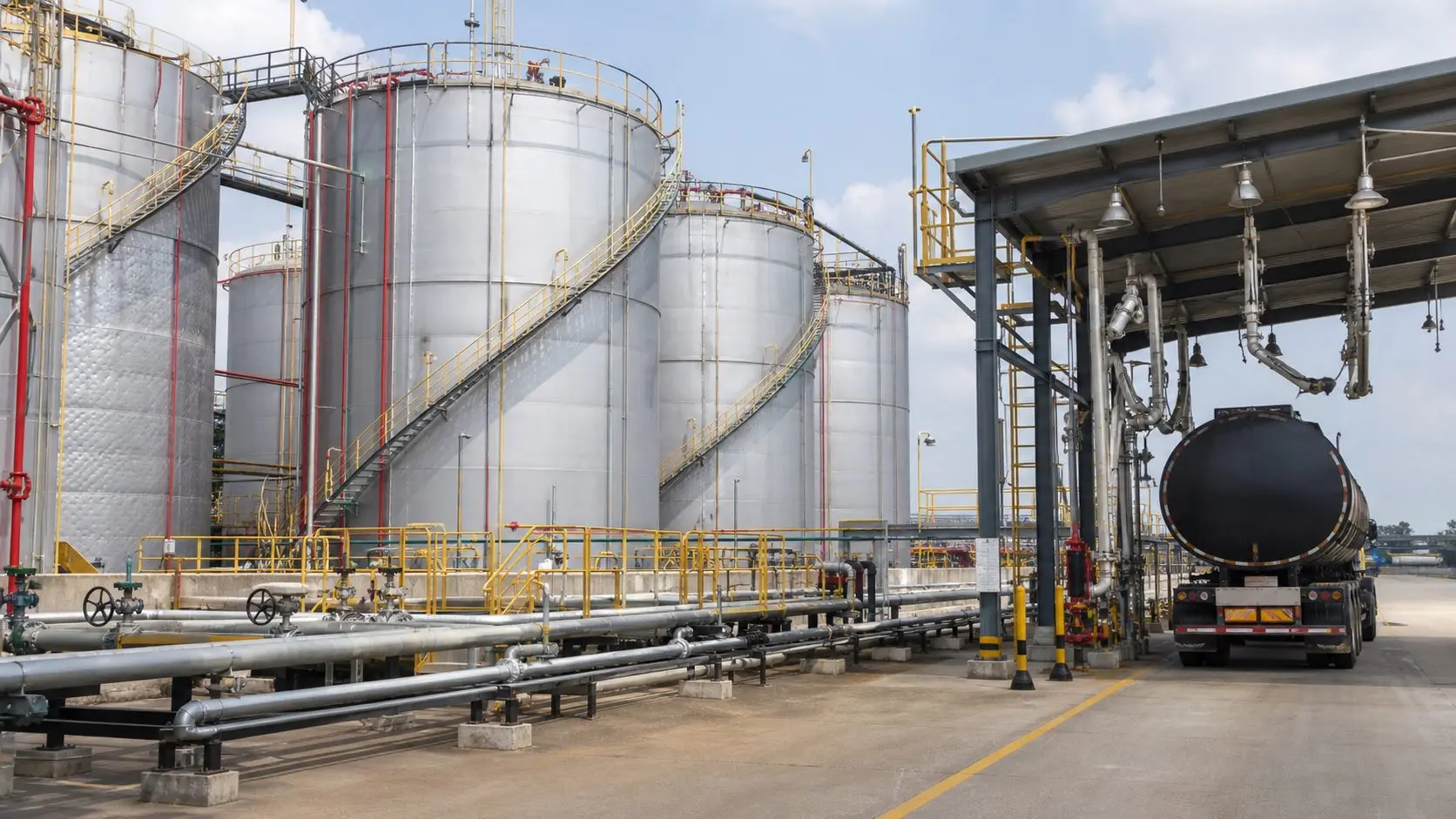
Bitumen density governs bulk liquid procurement, road tanker custody transfer, and storage tank ullage calculations. Unlike water (1,000 kg/m³), pure bituminous binder varies in density with crude source, penetration grade, polymer modification, and pumping temperature.
Volume to Mass Formula
The fundamental conversion between bitumen volume and mass is:
Example: A storage tank contains 40 m³ of bitumen with a density of 1,010 kg/m³:
Mass = 40 × 1,010 ÷ 1,000 = 40.4 t
This is the basis of every bitumen density calculator, bitumen volume calculation, and bulk cargo quantity invoice. On-site paving projects use a different density reference — see the tonnage calculator for compacted asphalt mix density (2,300–2,400 kg/m³).
How to Calculate Density of Bitumen
Density = mass ÷ volume. Divide kilograms by cubic metres to obtain kg/m³. For example, a measured 1,010 kg occupying 1 m³ has a density of 1,010 kg/m³, or 1.010 kg/L. This is an illustrative value, not a specification for every grade.
Use the measured density on the supplier's certificate and its reference temperature. A penetration grade alone does not determine density. Match the volume and density temperatures before multiplying them. Bitumen binder is a different material from asphalt mixture, which also contains aggregate; do not substitute compacted asphalt density in a binder cargo calculation.
How to Calculate Volume of Bitumen
The reverse calculation — converting mass to volume — is used for tank sizing, container loading, and delivery planning:
Example: You purchase 25,000 kg of 80/100 pen bitumen at an assumed density of 1,020 kg/m³ at the same reference temperature:
Volume = 25,000 ÷ 1,020 = 24.51 m³
Check the permitted working capacity of the actual container before using this volume in delivery planning.
Temperature Correction
Heating changes bitumen volume and density. Use the product's approved volume correction table or method and the reference temperature required by the contract. A single expansion coefficient is not a universal custody-transfer standard.
Illustrative example: If the approved factor for a shipment were 0.95, an observed volume of 40 m³ would become 38 m³ at the reference temperature. At a density of 1,010 kg/m³ at that same temperature, the calculated mass would be 38.38 metric tonnes. The factor 0.95 is an example, not a factor to use for an actual shipment.
Obtain the applicable factor from the supplier or inspection procedure. The temperature converter converts °C and °F only; it does not calculate a volume correction factor.
Cargo and Bulk Shipment Calculations
- Use the tank's calibrated measurement procedure to determine observed volume.
- Record the product temperature and the supplier's density with its reference temperature.
- Apply the contractually approved correction method to bring volume and density to the same reference temperature.
- Multiply cubic metres by kg/m³ and divide by 1,000 for metric tonnes.
- Reconcile the result with the delivery documentation and agreed measurement tolerances.
Storage Tank Planning
Nominal tank volume is not the same as its permitted working capacity. Use the tank design, operating procedure and supplier guidance for filling limits, heating and storage temperature. Polymer-modified binders may need different handling conditions.
See Eurobitume's storage guidance and the product safety data sheet. These quantity examples do not specify safe tank operating limits. Once the delivered mass is confirmed, the cost calculator can multiply tonnes by an entered price.